Missing headers expose vulnerabilities
Websites without proper security headers are more vulnerable to clickjacking, MIME-type sniffing, and other common attacks.
Loading...
Best Tools
Security headers protect websites against common attacks. Checking whether HSTS, X-Frame-Options, X-Content-Type-Options, and other headers are present helps agencies and developers identify missing security configurations.
No credit card required · Real checks only · Sample monitoring workflow shown
Website health signals, not live monitoring data
The Problem
Websites without proper security headers are more vulnerable to clickjacking, MIME-type sniffing, and other common attacks.
Security headers can be removed or misconfigured during site updates, redeployments, or CMS changes.
Manually inspecting response headers for each client site is time-consuming. A tool that automates the check saves time.
How It Works
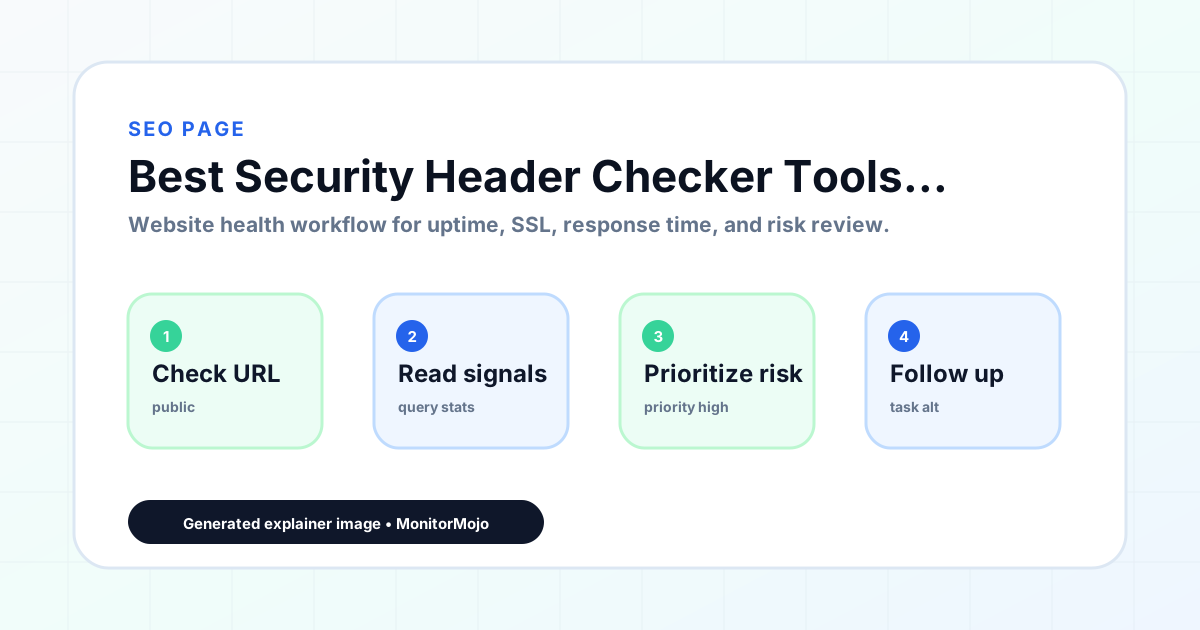
Enter the website, subdomain, or client property you need to protect.
Run a real reachability, HTTPS/SSL, response time, and configured health check.
Use the returned signals to decide what to fix before a browser error or complaint.
Features
Checks security headers alongside uptime, SSL, and response time. Includes HSTS, X-Frame-Options, X-Content-Type-Options, and more.
Dedicated security header analysis with letter grading. Deep technical assessment of header configurations.
Open-source security header scanner with best-practice recommendations. Good for compliance checks.
Who This Is For
Check security headers for client websites as part of regular health reviews.
Verify headers during staging and after production deployments.
Quickly audit multiple client websites for missing or misconfigured security headers.
Workflow Guide
Compare the best security header checker tools for auditing HTTP response headers. MonitorMojo, Security Headers, and other tools compared.
In practice, that means reviewing response time, server latency, deployment changes, caching behavior, and third-party dependencies from one repeatable process instead of waiting for site owners and small teams to hear about a problem secondhand. A check can show whether a URL is reachable, whether SSL appears valid, how quickly the server responds, and whether selected headers are present — it does not replace a security audit or an incident-response team, but it makes the underlying signals visible before they turn into a bigger issue.
This is built for site owners and small teams — specifically for the moment of running a routine check before a visitor finds the problem first. Websites without proper security headers are more vulnerable to clickjacking, MIME-type sniffing, and other common attacks. The same workflow is reusable by anyone with a public URL tied to revenue, leads, or reputation.
Start by listing the URLs that actually matter for running a routine check before a visitor finds the problem first — not every page on the site, just the ones tied to revenue, signups, or trust. Define the check types for each: reachability, HTTP status, HTTPS/SSL status and expiry window, response time, redirects, and security header presence.
Set a cadence that matches the risk: a monthly review for low-traffic pages, a check right after every deploy for anything tied to revenue. When something fails, triage before assuming cause — hosting, DNS, SSL, code, cache, or a third-party script could all be responsible. Record an owner and a next review date, then re-check after the fix ships.
Use this template for every review: [URL], [Check Type], [Status], [Issue], [Priority], [Owner], [Detected Date], [Next Review Date]. Describe what the check observed before assigning a root cause — 'response time increased' is a fact, 'hosting is the problem' is a guess until confirmed.
For a recurring report, group findings by reachability, SSL, response time, and security headers, and say plainly when a signal showed no issue rather than implying full coverage.
The most common miss for site owners and small teams is checking only the homepage while a checkout, signup, or booking flow silently breaks. A close second is assuming SSL auto-renewal always works — it can fail quietly, and an external check is the only way to catch it before a browser warning does. The biggest framing mistake is treating one clean check as proof the whole site is covered.
Picture running a routine check before a visitor finds the problem first. A scheduled check flags that a key page is slower than its usual baseline and a security header is missing. Checks security headers alongside uptime, SSL, and response time. Includes HSTS, X-Frame-Options, X-Content-Type-Options, and more. Instead of guessing, the team logs the observation, assigns an owner, and re-checks after the fix — turning "something feels off" into a closed-loop task with a timestamp attached.
MonitorMojo runs the checks behind best security header checker tools for 2026 — reachability, SSL, response time, and security headers — from one dashboard, with an API and CLI for teams that want it scripted into an existing workflow. Credit-based checks make it practical to run a review exactly when it matters: before a client call, after a deploy, or the moment someone asks whether the site is healthy.
FAQ
HTTP security headers are response headers that tell browsers how to handle website content securely. Common headers include HSTS, X-Frame-Options, X-Content-Type-Options, and Content-Security-Policy.
Security headers protect against attacks like clickjacking, MIME-type sniffing, and cross-site scripting. Missing headers leave websites more vulnerable.
Yes. MonitorMojo checks for key security headers including HSTS, X-Frame-Options, X-Content-Type-Options, and others as part of its website health check.