MonitorMojo Blog
How to Connect Website Monitoring to AI Workflows
Connecting website monitoring to AI workflows lets you build intelligent monitoring solutions that can analyze data, detect patterns, and provide insights. This guide shows you how to connect website monitoring to AI workflows, with step-by-step workflows and integration patterns. This expanded guide explains the practical monitoring workflow behind the topic, who should use it, what to check, how to document findings, and how to turn website health signals into useful client, developer, API, CLI, or AI-agent workflows without overstating what monitoring can prove.
Why Connect Monitoring to AI Workflows
Connecting website monitoring to AI workflows lets you build intelligent monitoring solutions that can analyze data, detect patterns, and provide insights. Instead of just collecting data, AI can help you understand what the data means.
AI can analyze trends over time, detect anomalies, predict issues before they occur, and provide recommendations for improvement. This transforms monitoring from a reactive tool to a proactive intelligence system.
This guide shows you how to connect website monitoring to AI workflows, with step-by-step workflows and integration patterns.
Integrating Monitoring Data with AI
Start by collecting monitoring data using the MonitorMojo API. The API returns structured JSON data that is easy for AI systems to parse and analyze.
Next, feed the data into your AI system. This might be a machine learning model, a natural language processing system, or any other AI system that can analyze the data.
Then, define what the AI should do with the data. This might include analyzing trends, detecting anomalies, predicting issues, or providing recommendations.
Finally, integrate the AI insights back into your monitoring workflow. The AI can provide insights to users, trigger automated actions, or update dashboards with intelligent analysis.
Integration Patterns for AI Workflows
AI workflows can integrate with various systems: dashboards, alerting systems, automated workflows, and more. The key is providing structured data that these systems can understand and act on.
For dashboards, the AI can provide intelligent analysis and insights. For alerting systems, the AI can predict issues before they occur and alert you proactively. For automated workflows, the AI can trigger actions based on intelligent analysis.
MonitorMojo provides structured JSON responses that are easy for AI systems to parse. Each check returns comprehensive health data in a format that AI systems can work with.
The API also provides historical data, so your AI system can analyze trends over time and provide more intelligent insights.
Common Integration Mistakes
Not providing structured data is a common mistake. AI systems need structured data they can parse and analyze. Unstructured data is hard for AI to work with.
Not defining clear workflows is another mistake. Your AI system needs to know what to do with the data. Without clear workflows, the AI will not be effective.
Not testing the integration is a third mistake. You need to verify that your AI system can successfully call the API, parse the results, and provide intelligent insights. Testing reveals gaps before they become problems.
Not monitoring the AI system itself is a fourth mistake. If your AI system fails, you need to know. Monitor the AI system to ensure it is running successfully and providing value.
How MonitorMojo Helps with AI Integration
MonitorMojo provides a REST API that returns structured JSON data. Each health check returns comprehensive health data in a format that AI systems can work with.
The API is designed for AI integration. It provides clear endpoints, structured responses, and comprehensive documentation. Your AI system can run checks, retrieve results, and analyze trends with minimal effort.
MonitorMojo also provides historical data, so your AI system can analyze trends over time and provide more intelligent insights.
The credit-based pricing means you only pay for the checks you run. No per-site monthly fees. This makes it easy to scale your AI monitoring without breaking the budget.
What this workflow means
How to Connect Website Monitoring to AI Workflows is best understood as a repeatable website health workflow, not a promise that every outage or configuration issue will be avoided. Learn how to connect website monitoring to AI workflows, integrate monitoring data with AI systems, and build intelligent monitoring solutions.
In practice, this workflow centers on uptime, SSL certificates, response time, security headers, website health summaries, and monthly review notes. Each check is planning input: it can show that the site is reachable, that a certificate has a given expiry window, that response time has shifted, or that a header is missing. It cannot prove root cause by itself or replace a human response. The value is in making the review consistent enough that site owners and small teams can spot issues before someone downstream has to ask about them.
Who should use this
This is most useful for site owners and small teams. Developers building AI-powered monitoring solutions
Beyond that primary audience, the same checks are reusable by anyone with a public-facing URL that matters to revenue, leads, or reputation: a recurring review is cheap insurance compared to hearing about the problem from a client or customer first.
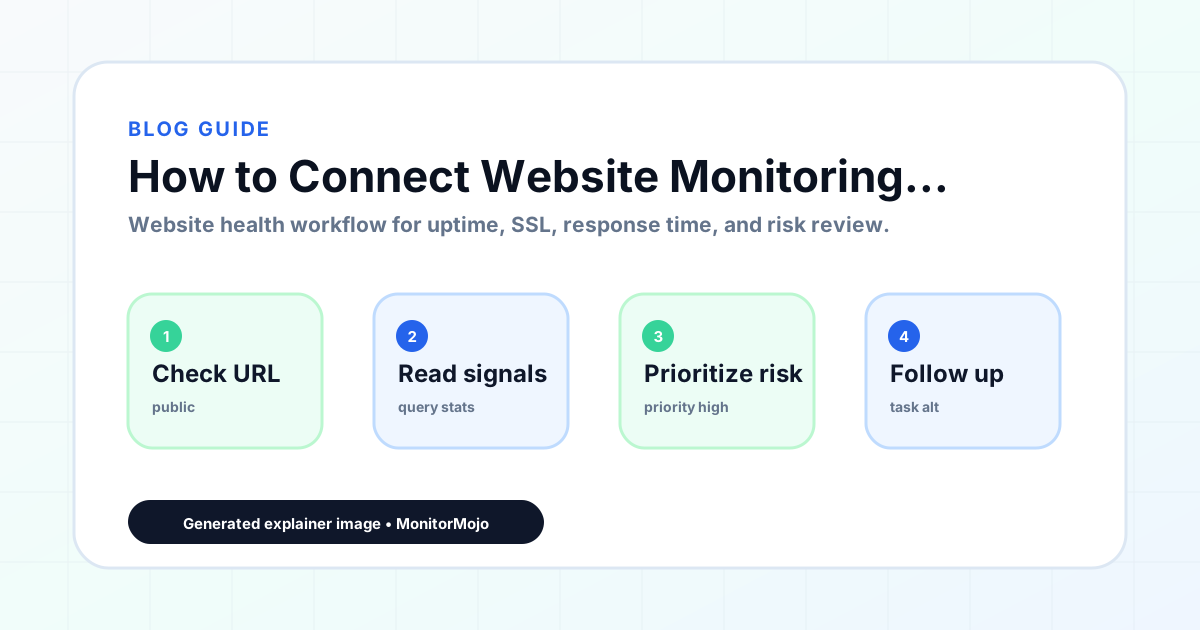
Step-by-step monitoring workflow
Start by listing the URLs that actually matter instead of just the homepage — for a small team doing a routine check before something breaks in front of a visitor, that usually means the pages tied to revenue, signups, or trust, not every page on the site.
Next, define the check types for each URL: reachability, HTTP status, HTTPS/SSL certificate status and expiry window, response time, redirect behavior, and security header presence. For API, CLI, and AI-agent workflows, document which endpoint or command runs the check and where the result is stored.
Set a cadence that matches the risk — a low-traffic page may only need a monthly look, while a page tied to revenue or signups deserves a check after every deployment and before any campaign or launch.
Record what you find with a consistent format: URL, check type, status, issue, owner, detected date, and next review date. Then say what actually happened in plain language — a check can surface a symptom, but site owners and small teams still need to confirm the cause.
- Choose the URLs that matter most to visitors, clients, revenue, and operations.
- Run uptime, SSL, response time, and security header checks on a consistent schedule.
- Triage failed or risky checks by likely owner: hosting, DNS, SSL, code, platform, or third party.
- Record notes in a repeatable format so future reviews do not start from scratch.
- Send a plain-language summary with the issue, impact, owner, and next review date.
- Run a confirmation check after remediation so there is an external result to reference.
Checklist or template
Use this template for recurring reviews: [URL], [Check Type], [Status], [Issue], [Priority], [Owner], [Detected Date], [Resolved Date], [Next Review Date]. Add a one-line summary at the top: what changed, what needs attention, and who owns the next step.
For site owners and small teams, group findings into the four signals that matter most: reachability, SSL status, response time, and security headers. Where nothing needs action, say the check found no issue in that area rather than implying full coverage.
- [URL]: the exact page or endpoint checked.
- [Check Type]: uptime, SSL, response time, headers, API, CLI, or agent workflow.
- [Status]: pass, review, failed, blocked, or needs human investigation.
- [Issue]: the observable symptom, not an unsupported root-cause claim.
- [Owner]: agency, developer, host, DNS provider, client, or third-party vendor.
- [Next Review Date]: when the team should confirm status again.
Common mistakes
The most common mistake is monitoring only the homepage while a checkout, signup, or booking flow silently breaks. Another is assuming SSL auto-renewal always works — it can fail quietly, and an external check is the only way to catch that before a browser warning does.
For site owners and small teams specifically, the recurring miss is treating one clean check as proof the whole site is fine, or fixing an issue without ever writing down what happened — which means the next person repeats the same investigation from zero.
- Tracking too many low-value URLs while missing the ones that matter.
- Skipping notes after an issue is resolved.
- Reporting a status without an owner or next step attached.
- Assuming automation can resolve an incident without human review.
- Treating one clean check as proof that every risk is covered.
Practical example
Consider a small team doing a routine check before something breaks in front of a visitor. A scheduled check flags that the site is slower than its usual baseline and that a security header is missing. Instead of guessing, the team logs the observation with a timestamp, assigns an owner, and re-checks after the fix ships — turning a vague "something feels off" into a specific, closed-loop task.
How MonitorMojo helps
MonitorMojo runs website health checks that combine reachability, SSL certificate status, response time, and security header presence in one workspace, so this workflow doesn't require stitching together several separate tools.
The API and CLI make the same checks scriptable for site owners and small teams who want them wired into an existing process, while credit-based checks keep it practical to run reviews exactly when they matter — before a client call, after a deploy, or when someone asks whether the site is healthy. Results still depend on hosting, DNS, and how quickly the responsible team acts on what the check finds.
Who this is for
- Developers building AI-powered monitoring solutions
- AI engineers integrating monitoring into AI workflows
- Teams building intelligent monitoring systems
- Anyone connecting monitoring data with AI
Frequently Asked Questions
How do I connect monitoring to AI workflows?
Collect monitoring data using the API, feed it into your AI system, define what the AI should do with the data, and integrate the AI insights back into your monitoring workflow.
What data does the API return?
The API returns structured JSON data including uptime status, SSL certificate details, response time, security headers, and more.
How do I integrate the API with my AI system?
The API provides clear endpoints and structured responses. Your AI system can call the API, parse the JSON results, and analyze the data.
Can the AI analyze trends over time?
Yes. MonitorMojo provides historical data, so your AI system can analyze trends over time and provide more intelligent insights.
How does MonitorMojo help with AI integration?
MonitorMojo provides a REST API with structured JSON responses, comprehensive documentation, and historical data. Credit-based pricing makes it easy to scale.
Can this prevent every issue with the site?
No. Monitoring helps site owners and small teams detect website health signals and organize follow-up, but it does not prevent every outage, SSL issue, slow response, or third-party failure. The result still depends on hosting, DNS, infrastructure, and how quickly the responsible team investigates and responds.