Web agencies
Check uptime, SSL, and headers for multiple client sites without configuring separate monitors.
Loading...
Comparison
StatusCake is an uptime monitoring platform that offers multi-location checks, domain monitoring, and public status pages. MonitorMojo is a website monitoring and health-check platform for agencies and small teams that combines uptime checks, SSL monitoring, response time analysis, security header checks, and client reporting.
| Capability | MonitorMojo | StatusCake |
|---|---|---|
| Uptime monitoring | ✓Multi-location uptime checks | On-demand checks + monitoring workspace |
| SSL certificate monitoring | ✓SSL monitoring on higher plans | SSL validity and expiry inspection |
| Security header checks | ✓Not available | Security header presence checks |
| Client reporting | ✓Public status pages | Copyable check summaries |
| Agency workflow | ✓Team features on pro plans | Built for agency and client workflows |
| Domain monitoring | ✓Domain expiry checks | Domain and SSL risk signals |
| Setup complexity | ✓Configuration required | Enter URL and run a check |
Who This Is For
Check uptime, SSL, and headers for multiple client sites without configuring separate monitors.
Run health checks on maintained sites and share results without extra report tooling.
Get a broader view of website health without juggling multiple monitoring services.
When to choose MonitorMojo
MonitorMojo checks uptime, SSL, response time, AND security headers in one workflow. StatusCake focuses primarily on uptime.
Every check generates a copyable summary designed for agency-client communication.
Start checking immediately without setting up probes, monitors, or notification channels.
Workflow Guide
StatusCake is an uptime monitoring platform that offers multi-location checks, domain monitoring, and public status pages. MonitorMojo is a website monitoring and health-check platform for agencies and small teams that combines uptime checks, SSL monitoring, response time analysis, security header checks, and client reporting.
The practical question is how your team actually works, not which tool has a longer feature list. StatusCake may be the better fit for teams that specifically need its monitoring model or alerting depth. MonitorMojo is built around Uptime monitoring, SSL certificate monitoring, Security header checks, Client reporting, packaged for agencies, founders, and developers who want a website health workflow they can run consistently rather than a heavier observability platform.
Broader health signals: MonitorMojo checks uptime, SSL, response time, AND security headers in one workflow. StatusCake focuses primarily on uptime.
Client-ready output: Every check generates a copyable summary designed for agency-client communication.
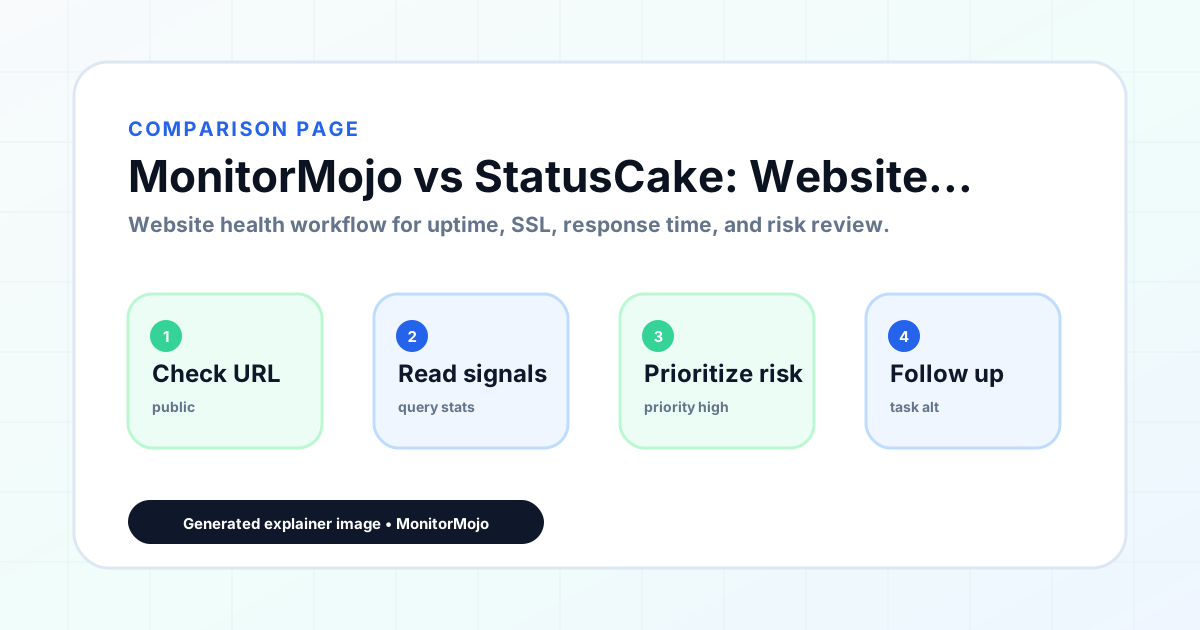
Start by listing the URLs you actually need checked: homepage, pricing, signup, checkout, and anything tied to revenue or client trust. Then confirm both StatusCake and MonitorMojo cover the signals that matter for your workflow: Uptime monitoring, SSL certificate monitoring, Security header checks, Client reporting.
Run the same check in both tools, assign an owner to whatever it finds, and write the stakeholder summary you'd actually send. A tool that's powerful but rarely used is worth less than a simpler one your team repeats every month.
Compare setup time, pricing model, API/CLI access, and reporting clarity side by side for MonitorMojo and StatusCake. For agencies: does it produce a client-ready summary without extra rework? For developers: does the API or CLI fit an existing deploy pipeline? For solo founders: can you run a check in under a minute without reading documentation first?
Pick three or four representative URLs and run the identical check in StatusCake and MonitorMojo. Compare how each surfaces reachability, SSL status, response time, and header findings — and, more importantly, how much work it takes to turn that output into something a client or teammate can act on.
A comparison should include the people who'll actually read the results. Agencies need a client-ready summary; founders need a fast yes/no before a launch; developers need status detail right after a deploy. Test whether StatusCake and MonitorMojo both make that summary easy to produce every month, not just during the free trial.
Don't decide based on feature-table length alone — StatusCake may include capabilities your team will never touch, and a narrower tool can still be the better operational fit. Don't assume either tool prevents outages or replaces a security review; both are detection and reporting layers, not incident-response teams.
Both MonitorMojo and StatusCake can show that a URL responded at a given time, that SSL data was visible, or that a header was missing. Neither can prove root cause on its own or replace a human response. Judge the comparison on how well each tool helps your team observe, document, and follow up — not on which one promises the most.
Which tool makes it easiest to check the URLs that matter to you? Which one turns a finding into a clear owner and next step with the least manual work? Which pricing model matches how often you'll actually run checks? Run the same [Website URL] through both, write the same summary, and see which one gets you to a decision faster.
Close the comparison with a decision, not a blanket claim. Name the tool that fits your workflow and why, and be explicit about what monitoring — from either vendor — cannot do: it won't remove outages or replace a human incident response.
MonitorMojo runs website health checks for uptime, SSL, response time, and security headers from one dashboard, with an API and CLI for teams that want it scriptable. It's built as an alternative to StatusCake for teams that want a simpler, more client-friendly workflow — not a full observability replacement.