MonitorMojo Blog
Best Website Monitoring Tools for Small Businesses
The best website monitoring tool for a small business is not necessarily the most powerful or the most widely known — it is the one that covers the right signals, fits the budget, and is simple enough to actually use on a consistent basis. For small business owners managing a website without a dedicated IT team, the criteria are different from those of an enterprise engineering department. This guide explains what to look for and how to evaluate your options. This expanded guide explains the practical monitoring workflow behind the topic, who should use it, what to check, how to document findings, and how to turn website health signals into useful client, developer, API, CLI, or AI-agent workflows without overstating what monitoring can prove.
What small businesses actually need from a monitoring tool
Small businesses do not need real user monitoring, synthetic transaction testing, distributed tracing, or on-call escalation workflows. They need reliable answers to practical questions: is the website up, is the SSL certificate valid and not about to expire, is the site fast enough to hold visitor attention, and are the basic browser security protections in place.
A monitoring tool that covers these signals clearly and consistently — without requiring technical setup, ongoing configuration, or a monitoring budget sized for an enterprise — is the right tool for a small business. Complexity is not a virtue here; it is an obstacle to consistent use.
The best monitoring tools for small businesses are the ones that get used every month. A sophisticated platform that sits unused because it is too complex to maintain is worse than a simple tool that runs a health check reliably every time someone remembers to check.
Key signals to look for in a website monitoring tool
SSL certificate monitoring is the highest-priority signal for most small business websites. Certificate expiry creates immediate, complete visitor-facing failure — browsers block the site with a warning screen — and it is entirely preventable with early warning. Any monitoring tool worth using for a small business should surface SSL expiry dates clearly.
Reachability and HTTP status codes are the foundation: is the site responding, and is it returning a success code or an error? Response time monitoring catches the slower failure mode where the site is technically accessible but too slow to hold visitor attention. Security header checking surfaces configuration gaps that affect browser-level security.
Domain risk signals round out the picture: is the domain registration current, and are there any DNS signals worth noting? Together these five signal areas cover the failures most likely to affect a small business website and its visitors.
Continuous monitoring versus on-demand checks
Website monitoring tools fall into two broad categories: continuous monitoring tools that check a URL every few minutes and send automated alerts when something changes, and on-demand health check tools that run a comprehensive check when you choose to run it.
Continuous monitoring is valuable for businesses where every minute of downtime has measurable revenue impact and where someone is available to respond to alerts at any hour. For most small business websites — local service businesses, informational sites, small e-commerce stores — monthly health checks with additional checks after site changes cover the majority of monitoring value at much lower cost and complexity.
The choice depends on your business context. A local restaurant website probably does not need continuous monitoring with 5-minute checks. An online store with daily orders needs faster detection. Most small businesses fall closer to the monthly check end of this spectrum than they realize.
Pricing models and cost-effectiveness
Monitoring tool pricing models vary widely. Continuous monitoring tools typically charge per monitor or per website per month, which makes sense when running checks continuously. On-demand health check tools may use credit-based pricing, where you buy checks in advance and use them when needed — no ongoing subscription, no unused capacity.
For small businesses running monthly checks on one or a few websites, credit-based pricing is often more cost-effective than a monthly subscription. You pay for the checks you run rather than maintaining a subscription for an ongoing monitoring service you may not fully utilize.
Evaluate pricing based on your expected check volume, not on the feature set you might theoretically need. A $99/month enterprise monitoring subscription is not a good value for a small business that needs one monthly health check on one website.
Ease of use and time to first result
For a small business owner without a technical background, the most important quality of a monitoring tool is how quickly it produces a useful result. A tool that requires server configuration, agent installation, or complex onboarding is not going to be used consistently by a non-technical user.
The best small business monitoring tools are designed to get from 'I want to check my website' to 'I have a health summary' in under two minutes. You enter a URL, run the check, and see what needs attention in plain language. No setup, no configuration, no interpretation manual.
MonitorMojo is designed for this kind of non-technical use. You enter a URL and get a health summary covering reachability, SSL, response time, security headers, and domain risk — formatted for a business owner as much as for a developer. The output is clear enough to act on without needing to understand what each signal means technically.
What to look for in monitoring tool output
A monitoring tool's output is as important as the signals it checks. Raw technical data — HTTP headers in their original format, SSL certificate details in PEM encoding, response time percentiles across multiple locations — is useful for engineers but not for small business owners or agency clients who need to understand and act on the results.
The best monitoring tools translate technical results into clear status summaries: the SSL certificate is valid and expires in X days, the site responded in X milliseconds, these security headers are present and these are missing. Action-oriented output tells you what to do, not just what was found.
Look for tools whose output can be shared with a non-technical client or colleague without requiring translation. If the monitoring data is only useful to the person who ran the check, it is limiting the workflow unnecessarily.
What this workflow means
Best Website Monitoring Tools for Small Businesses is best understood as a repeatable website health workflow, not a promise that every outage or configuration issue will be avoided. A practical guide to the best website monitoring tools for small businesses — what to look for, which signals matter, and how to choose the right tool for your workflow.
In practice, this workflow centers on uptime, SSL certificates, response time, security headers, website health summaries, and monthly review notes. Each check is planning input: it can show that the site is reachable, that a certificate has a given expiry window, that response time has shifted, or that a header is missing. It cannot prove root cause by itself or replace a human response. The value is in making the review consistent enough that site owners and small teams can spot issues before someone downstream has to ask about them.
Who should use this
This is most useful for site owners and small teams. The common thread is a small team doing a routine check before something breaks in front of a visitor, where a missed signal costs more than the few minutes it takes to check.
Beyond that primary audience, the same checks are reusable by anyone with a public-facing URL that matters to revenue, leads, or reputation: a recurring review is cheap insurance compared to hearing about the problem from a client or customer first.
Step-by-step monitoring workflow
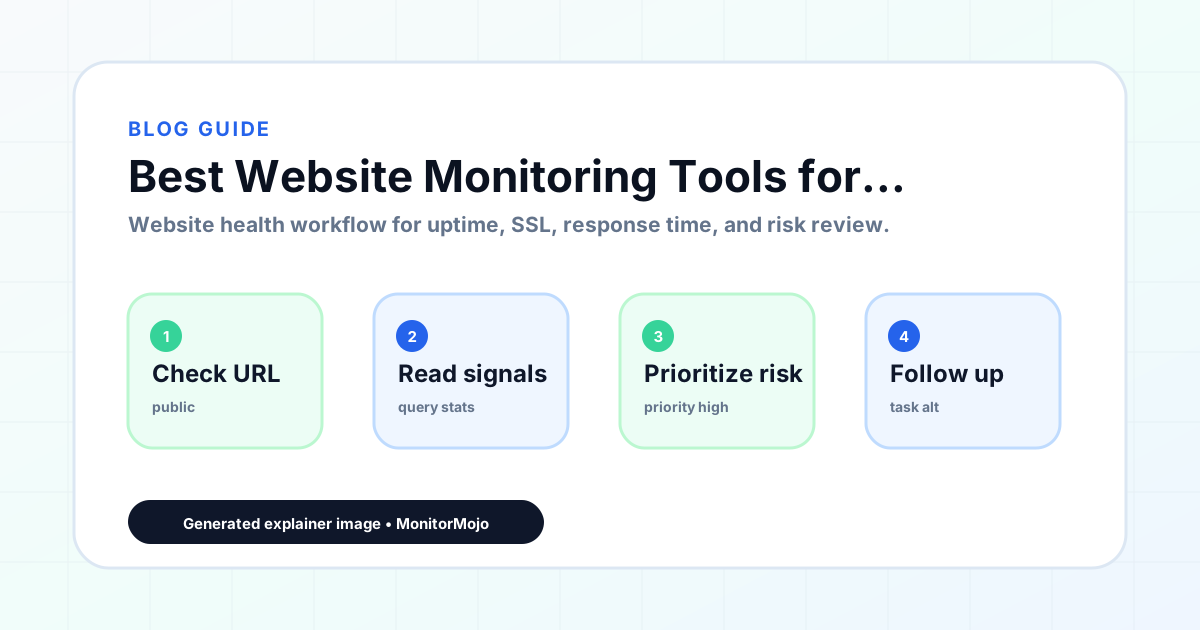
Start by listing the URLs that actually matter instead of just the homepage — for a small team doing a routine check before something breaks in front of a visitor, that usually means the pages tied to revenue, signups, or trust, not every page on the site.
Next, define the check types for each URL: reachability, HTTP status, HTTPS/SSL certificate status and expiry window, response time, redirect behavior, and security header presence. For API, CLI, and AI-agent workflows, document which endpoint or command runs the check and where the result is stored.
Set a cadence that matches the risk — a low-traffic page may only need a monthly look, while a page tied to revenue or signups deserves a check after every deployment and before any campaign or launch.
Record what you find with a consistent format: URL, check type, status, issue, owner, detected date, and next review date. Then say what actually happened in plain language — a check can surface a symptom, but site owners and small teams still need to confirm the cause.
- Choose the URLs that matter most to visitors, clients, revenue, and operations.
- Run uptime, SSL, response time, and security header checks on a consistent schedule.
- Triage failed or risky checks by likely owner: hosting, DNS, SSL, code, platform, or third party.
- Record notes in a repeatable format so future reviews do not start from scratch.
- Send a plain-language summary with the issue, impact, owner, and next review date.
- Run a confirmation check after remediation so there is an external result to reference.
Checklist or template
Use this template for recurring reviews: [URL], [Check Type], [Status], [Issue], [Priority], [Owner], [Detected Date], [Resolved Date], [Next Review Date]. Add a one-line summary at the top: what changed, what needs attention, and who owns the next step.
For site owners and small teams, group findings into the four signals that matter most: reachability, SSL status, response time, and security headers. Where nothing needs action, say the check found no issue in that area rather than implying full coverage.
- [URL]: the exact page or endpoint checked.
- [Check Type]: uptime, SSL, response time, headers, API, CLI, or agent workflow.
- [Status]: pass, review, failed, blocked, or needs human investigation.
- [Issue]: the observable symptom, not an unsupported root-cause claim.
- [Owner]: agency, developer, host, DNS provider, client, or third-party vendor.
- [Next Review Date]: when the team should confirm status again.
Common mistakes
The most common mistake is monitoring only the homepage while a checkout, signup, or booking flow silently breaks. Another is assuming SSL auto-renewal always works — it can fail quietly, and an external check is the only way to catch that before a browser warning does.
For site owners and small teams specifically, the recurring miss is treating one clean check as proof the whole site is fine, or fixing an issue without ever writing down what happened — which means the next person repeats the same investigation from zero.
- Tracking too many low-value URLs while missing the ones that matter.
- Skipping notes after an issue is resolved.
- Reporting a status without an owner or next step attached.
- Assuming automation can resolve an incident without human review.
- Treating one clean check as proof that every risk is covered.
Practical example
Consider a small team doing a routine check before something breaks in front of a visitor. A scheduled check flags that the site is slower than its usual baseline and that a security header is missing. Instead of guessing, the team logs the observation with a timestamp, assigns an owner, and re-checks after the fix ships — turning a vague "something feels off" into a specific, closed-loop task.
How MonitorMojo helps
MonitorMojo runs website health checks that combine reachability, SSL certificate status, response time, and security header presence in one workspace, so this workflow doesn't require stitching together several separate tools.
The API and CLI make the same checks scriptable for site owners and small teams who want them wired into an existing process, while credit-based checks keep it practical to run reviews exactly when they matter — before a client call, after a deploy, or when someone asks whether the site is healthy. Results still depend on hosting, DNS, and how quickly the responsible team acts on what the check finds.
Frequently Asked Questions
What is the best free website monitoring tool for small businesses?
Many monitoring tools offer free tiers with limited functionality. For basic uptime monitoring, UptimeRobot's free plan is widely used. For combined health checks covering SSL, response time, and security headers, MonitorMojo's credit-based model lets you run checks without a recurring subscription cost.
How often should a small business use a website monitoring tool?
Monthly health checks are the right cadence for most small business websites, with additional checks after website updates, hosting migrations, or any significant change to the site's setup. More frequent monitoring is appropriate if the website is a primary daily revenue channel.
Do I need technical knowledge to use a website monitoring tool?
No — at least not for tools designed for non-technical users. MonitorMojo is designed to give clear results that any website owner can understand without needing to interpret raw server logs, certificate chains, or HTTP response headers.
What is the difference between uptime monitoring and website health monitoring?
Uptime monitoring checks whether a server responds — a binary up-or-down signal. Website health monitoring covers a broader set of signals: reachability, SSL certificate status and expiry, response time, security headers, and domain health. For small businesses, website health monitoring provides a more complete and actionable picture.
Can I use MonitorMojo for my small business website?
Yes. MonitorMojo is designed for small business owners, freelancers, and agencies. You enter your website URL, run a health check, and get a clear summary covering all the key signals — no technical setup required. The credit-based pricing means you only pay when you run checks.
Can this prevent every issue with the site?
No. Monitoring helps site owners and small teams detect website health signals and organize follow-up, but it does not prevent every outage, SSL issue, slow response, or third-party failure. The result still depends on hosting, DNS, infrastructure, and how quickly the responsible team investigates and responds.