MonitorMojo Blog
HTTPS Checker: What to Review on Your Website
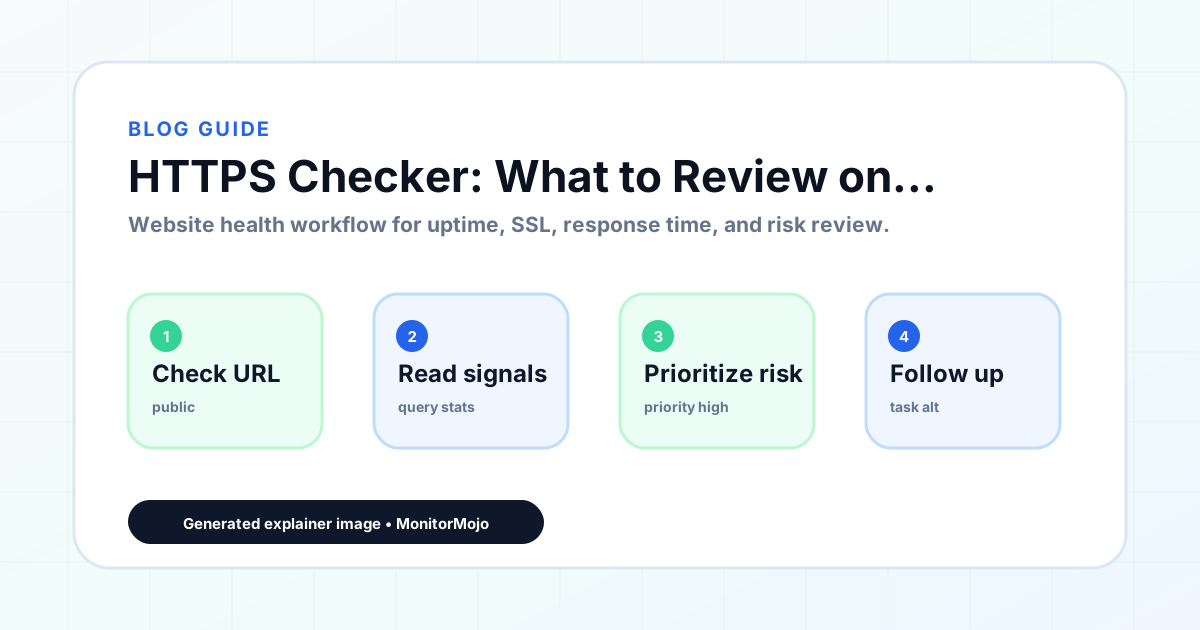
Most website owners assume that if their URL starts with 'https://' their HTTPS is working correctly. In practice, HTTPS configuration has several components that can each fail independently — the certificate itself, the redirect behavior from HTTP, the completeness of the certificate chain, and whether resources on the page are being loaded securely. An HTTPS checker reviews these signals systematically so you know what is actually working and what needs attention. This expanded guide explains the practical monitoring workflow behind the topic, who should use it, what to check, how to document findings, and how to turn website health signals into useful client, developer, API, CLI, or AI-agent workflows without overstating what monitoring can prove.
The difference between having HTTPS and having correct HTTPS
A website can have a valid SSL certificate but still have HTTPS configuration problems that affect visitors. The most common example is an HTTP-to-HTTPS redirect that is either missing or misconfigured. If someone types your domain without 'https://', they should be automatically redirected to the secure version. Without this redirect, visitors on unsecured connections are not protected — and browsers may flag the site as not fully secure.
Another common problem is mixed content, where an HTTPS page loads some resources — images, fonts, scripts — from HTTP URLs. This creates a situation where the page is technically served over HTTPS but some content is still transferred insecurely. Modern browsers handle mixed content in different ways, sometimes blocking the insecure resources silently.
Certificate chain problems are less visible but equally important. A complete certificate chain includes your site's certificate plus the intermediate certificates that connect it to a trusted root authority. If intermediate certificates are missing, some clients — particularly on mobile or in certain network environments — may not trust the certificate even though it appears valid in a desktop browser.
What an HTTPS checker reviews
A thorough HTTPS check covers: whether the certificate is valid and trusted, the expiry date and days remaining, whether the certificate matches the domain being accessed (including www vs. non-www), whether HTTP correctly redirects to HTTPS, whether the redirect chain is clean (not looping or making unnecessary hops), and whether the certificate chain is complete.
Security-conscious checks also review the TLS protocol version in use. Older TLS versions (TLS 1.0 and 1.1) are deprecated and disabled in most modern browsers, but some hosting configurations still advertise them. Using only TLS 1.2 or 1.3 is current best practice.
MonitorMojo's website health check includes HTTPS configuration review as part of the standard check — covering certificate validity, expiry timeline, and redirect behavior without requiring you to interpret raw SSL output.
Why HTTPS matters for trust, SEO, and browsers
HTTPS has been a Google search ranking signal since 2014. Sites that serve over HTTPS have a minor but real advantage over equivalent HTTP sites in organic search results. More importantly, Google Chrome marks HTTP sites as 'Not Secure' in the address bar — a label that many visitors interpret as a significant warning.
For sites that handle any kind of form submission — contact forms, newsletter signups, login credentials, payment information — HTTPS is essential. Without it, data submitted through forms is transmitted in plain text and can be intercepted on the network. Even for purely informational sites, the 'Not Secure' label undermines trust.
HTTPS also enables certain browser features — particularly service workers, which power offline functionality and push notifications — that are only available in secure contexts. For modern web applications, HTTPS is a prerequisite for full functionality, not just a trust signal.
Common HTTPS configuration mistakes
The most frequent HTTPS mistake is partial redirect implementation. Many sites redirect https://www.example.com but not https://example.com, or vice versa. Visitors using either version should land on the same secure canonical URL. Having inconsistent redirect behavior creates duplicate content issues and leaves some visitors on insecure connections.
Another common mistake is allowing the old HTTP URL to serve content rather than redirecting. If http://example.com returns a page instead of a 301 redirect to https://example.com, you have two versions of your site accessible simultaneously — one secure, one not.
Hosting migrations frequently break HTTPS configuration. When a site moves from one server to another, the SSL certificate, redirect rules, and .htaccess or nginx configuration all need to be explicitly verified in the new environment. Assuming they transferred correctly is one of the most reliable ways to create a post-migration HTTPS problem.
- Missing HTTP to HTTPS redirect
- Inconsistent www vs. non-www redirect behavior
- HTTP version serving content instead of redirecting
- Redirect chain too long or looping
- Certificate valid but not matching domain (subdomain mismatch)
- Mixed content loading HTTP resources on HTTPS pages
Checking HTTPS after common website changes
HTTPS configuration should be explicitly verified after any of the following: hosting migration, domain transfer, CDN implementation or removal, content management system update, SSL certificate renewal, or adding a new subdomain. Each of these changes can silently affect HTTPS behavior in ways that are not obvious until a visitor reports a problem.
For agencies, a pre-launch HTTPS check is a sensible addition to any site deployment checklist. It takes minutes and catches the category of problems that most commonly appear in post-launch client feedback.
A post-migration HTTPS check is particularly important because the old site may have cached redirect rules or SSL configurations in your browser, making the new site appear healthy when it is not. Running the check from an external tool — separate from your browser and network — gives you an accurate picture.
Reading HTTPS check results without technical expertise
HTTPS check results can look intimidating when presented as raw certificate data or HTTP response headers. The most useful monitoring tools translate these results into plain-language status summaries: the certificate is valid, expires in X days, the HTTP redirect is working, the certificate matches the domain.
For non-technical website owners, the key questions are: Is the padlock showing? Does the certificate cover my domain? When does it expire? Is the HTTP redirect working? A good HTTPS checker answers all of these without requiring you to read certificate authority chains or TLS handshake logs.
MonitorMojo presents HTTPS check results alongside uptime and response time in a format designed for non-technical owners and agency clients. You get a clear summary of what is healthy and what needs attention — and the output translates directly into client reporting if needed.
What this workflow means
HTTPS Checker: What to Review on Your Website is best understood as a repeatable website health workflow, not a promise that every outage or configuration issue will be avoided. A practical guide to what an HTTPS checker reviews, why HTTPS configuration matters beyond just having a certificate, and what to look for on your website.
In practice, this workflow centers on uptime, SSL certificates, response time, security headers, website health summaries, and monthly review notes. Each check is planning input: it can show that the site is reachable, that a certificate has a given expiry window, that response time has shifted, or that a header is missing. It cannot prove root cause by itself or replace a human response. The value is in making the review consistent enough that site owners and small teams can spot issues before someone downstream has to ask about them.
Who should use this
This is most useful for site owners and small teams. The common thread is a small team doing a routine check before something breaks in front of a visitor, where a missed signal costs more than the few minutes it takes to check.
Beyond that primary audience, the same checks are reusable by anyone with a public-facing URL that matters to revenue, leads, or reputation: a recurring review is cheap insurance compared to hearing about the problem from a client or customer first.
Step-by-step monitoring workflow
Start by listing the URLs that actually matter instead of just the homepage — for a small team doing a routine check before something breaks in front of a visitor, that usually means the pages tied to revenue, signups, or trust, not every page on the site.
Next, define the check types for each URL: reachability, HTTP status, HTTPS/SSL certificate status and expiry window, response time, redirect behavior, and security header presence. For API, CLI, and AI-agent workflows, document which endpoint or command runs the check and where the result is stored.
Set a cadence that matches the risk — a low-traffic page may only need a monthly look, while a page tied to revenue or signups deserves a check after every deployment and before any campaign or launch.
Record what you find with a consistent format: URL, check type, status, issue, owner, detected date, and next review date. Then say what actually happened in plain language — a check can surface a symptom, but site owners and small teams still need to confirm the cause.
- Choose the URLs that matter most to visitors, clients, revenue, and operations.
- Run uptime, SSL, response time, and security header checks on a consistent schedule.
- Triage failed or risky checks by likely owner: hosting, DNS, SSL, code, platform, or third party.
- Record notes in a repeatable format so future reviews do not start from scratch.
- Send a plain-language summary with the issue, impact, owner, and next review date.
- Run a confirmation check after remediation so there is an external result to reference.
Checklist or template
Use this template for recurring reviews: [URL], [Check Type], [Status], [Issue], [Priority], [Owner], [Detected Date], [Resolved Date], [Next Review Date]. Add a one-line summary at the top: what changed, what needs attention, and who owns the next step.
For site owners and small teams, group findings into the four signals that matter most: reachability, SSL status, response time, and security headers. Where nothing needs action, say the check found no issue in that area rather than implying full coverage.
- [URL]: the exact page or endpoint checked.
- [Check Type]: uptime, SSL, response time, headers, API, CLI, or agent workflow.
- [Status]: pass, review, failed, blocked, or needs human investigation.
- [Issue]: the observable symptom, not an unsupported root-cause claim.
- [Owner]: agency, developer, host, DNS provider, client, or third-party vendor.
- [Next Review Date]: when the team should confirm status again.
Common mistakes
The most common mistake is monitoring only the homepage while a checkout, signup, or booking flow silently breaks. Another is assuming SSL auto-renewal always works — it can fail quietly, and an external check is the only way to catch that before a browser warning does.
For site owners and small teams specifically, the recurring miss is treating one clean check as proof the whole site is fine, or fixing an issue without ever writing down what happened — which means the next person repeats the same investigation from zero.
- Tracking too many low-value URLs while missing the ones that matter.
- Skipping notes after an issue is resolved.
- Reporting a status without an owner or next step attached.
- Assuming automation can resolve an incident without human review.
- Treating one clean check as proof that every risk is covered.
Practical example
Consider a small team doing a routine check before something breaks in front of a visitor. A scheduled check flags that the site is slower than its usual baseline and that a security header is missing. Instead of guessing, the team logs the observation with a timestamp, assigns an owner, and re-checks after the fix ships — turning a vague "something feels off" into a specific, closed-loop task.
How MonitorMojo helps
MonitorMojo runs website health checks that combine reachability, SSL certificate status, response time, and security header presence in one workspace, so this workflow doesn't require stitching together several separate tools.
The API and CLI make the same checks scriptable for site owners and small teams who want them wired into an existing process, while credit-based checks keep it practical to run reviews exactly when they matter — before a client call, after a deploy, or when someone asks whether the site is healthy. Results still depend on hosting, DNS, and how quickly the responsible team acts on what the check finds.
Frequently Asked Questions
What is the difference between HTTP and HTTPS?
HTTPS (HyperText Transfer Protocol Secure) encrypts the connection between a visitor's browser and your website's server using SSL/TLS. HTTP connections are unencrypted, meaning data transmitted — including form submissions — can be intercepted. HTTPS also triggers the padlock icon in browsers and is a Google ranking signal.
My site shows a padlock — does that mean HTTPS is fully configured?
Not necessarily. The padlock indicates that the page itself was served over HTTPS, but it does not confirm that HTTP visitors are being redirected, that all resources are being loaded securely, or that the certificate chain is complete. An HTTPS checker verifies all of these signals.
How do I check if my HTTP to HTTPS redirect is working?
You can test manually by typing http:// followed by your domain in a browser and checking whether you end up at the https:// version. An HTTPS checker automates this test and also reviews the redirect chain to ensure it is clean and not creating extra hops.
Does having HTTPS affect my Google ranking?
Yes, HTTPS is a confirmed ranking signal for Google. It is a relatively lightweight factor compared to content relevance and backlinks, but it does contribute. More importantly, Chrome marks HTTP sites as Not Secure, which affects user trust and conversion rates independently of search ranking.
What should I check after moving my website to a new host?
After a hosting migration, verify that the SSL certificate is correctly installed for your domain, that HTTP redirects to HTTPS, that the correct domain (www or non-www) is being served canonically, and that all pages return 200 status codes rather than errors. MonitorMojo's website health check covers these signals.
Can this prevent every issue with the site?
No. Monitoring helps site owners and small teams detect website health signals and organize follow-up, but it does not prevent every outage, SSL issue, slow response, or third-party failure. The result still depends on hosting, DNS, infrastructure, and how quickly the responsible team investigates and responds.