MonitorMojo Blog
MonitorMojo vs WordPress Monitoring Plugins: Why External Checks Matter
WordPress has plugins for almost everything, including website monitoring. Tools like Jetpack, WP Umbrella, ManageWP, and various security plugins include some form of uptime monitoring. But there is a fundamental limitation in all monitoring that runs from inside a WordPress installation: it cannot monitor the WordPress installation itself. External website health checks solve this problem. This expanded guide explains the practical monitoring workflow behind the topic, who should use it, what to check, how to document findings, and how to turn website health signals into useful client, developer, API, CLI, or AI-agent workflows without overstating what monitoring can prove.
How WordPress monitoring plugins work
WordPress monitoring plugins typically work in one of two ways. Some use a service component that pings the site from outside — similar to basic uptime monitors — and report availability. Others monitor internal WordPress health signals: plugin version status, PHP version compatibility, database table health, memory usage, or security scan results.
Internal monitoring gives you useful information about the WordPress installation's operational state. It can surface issues like a plugin conflict, an outdated PHP version, or a security vulnerability in an installed plugin. This is genuinely valuable for WordPress maintenance.
But both approaches have a critical blind spot: they depend on WordPress being functional enough to run the monitoring code. If WordPress itself goes down — due to a PHP error, a database failure, a server configuration change, or a malicious change that disables core functionality — the monitoring plugin cannot tell you, because the monitoring plugin is also down.
What external health checks see that plugins cannot
An external health check tests the website as a real visitor would experience it, from outside the hosting environment. It does not depend on WordPress being functional. If WordPress is returning a blank page, a 500 error, or a white screen of death, an external check sees that immediately — regardless of whether any plugin is running.
External checks also see signals that WordPress plugins typically do not surface: the exact SSL certificate expiry date (with the specific number of days remaining), the HTTP response code for real visitor requests, the server response time as experienced from outside the network, and specific security response headers returned by the server.
These signals are particularly important for agencies managing client sites. An SSL certificate expiry affects every visitor to the site, regardless of what WordPress reports internally. A server response time problem is visible to every user, regardless of what the WordPress dashboard shows.
Where WordPress plugins add unique value
WordPress monitoring plugins are best at what external checks cannot do: reviewing the internal health of the WordPress installation itself. Plugin version currency, PHP compatibility, database table integrity, backup status, and login security are all areas where a WordPress-aware tool has access to information that an external check cannot see.
For agencies managing WordPress care plans, the combination of both approaches is more comprehensive than either alone. External checks verify that the site is available, secure, and performing well for visitors. Internal WordPress tools verify that the installation is current, configured correctly, and not vulnerable to known issues.
MonitorMojo focuses on the external check layer — the signals that affect real visitor experience — and works alongside whatever internal WordPress management tools the agency uses.
The case for external checks as the primary monitoring layer
For website health monitoring purposes — the kind that feeds into client care plan reports — external checks should be the primary reference point. The question for a care plan is not 'is WordPress running healthy code' but 'is the website available, secure, and performing correctly for visitors.' External checks answer that question directly.
External checks are also platform-agnostic. They work the same way whether the website is WordPress, Webflow, Squarespace, a custom HTML site, or a JavaScript application. For agencies managing a mixed portfolio of website platforms, a single external check tool covers all of them consistently.
MonitorMojo is an external health check tool that works with any website URL, regardless of the underlying technology. It gives you reachability, SSL, response time, security headers, and domain risk signals for any site you need to review.
What this workflow means
MonitorMojo vs WordPress Monitoring Plugins: Why External Checks Matter is best understood as a repeatable website health workflow, not a promise that every outage or configuration issue will be avoided. Compare external website health checks to WordPress monitoring plugins. See why external checks catch what plugins inside the site cannot see.
In practice, this workflow centers on uptime, SSL certificates, response time, security headers, website health summaries, and monthly review notes. Each check is planning input: it can show that a WordPress client site is reachable, that a certificate has a given expiry window, that response time has shifted, or that a header is missing. It cannot prove root cause by itself or replace a human response. The value is in making the review consistent enough that WordPress maintenance providers can spot issues before someone downstream has to ask about them.
Who should use this
This is most useful for WordPress maintenance providers. The common thread is a WordPress care-plan provider reviewing client sites after a plugin update, where a missed signal costs more than the few minutes it takes to check.
Beyond that primary audience, the same checks are reusable by anyone with a public-facing URL that matters to revenue, leads, or reputation: a recurring review is cheap insurance compared to hearing about the problem from a client or customer first.
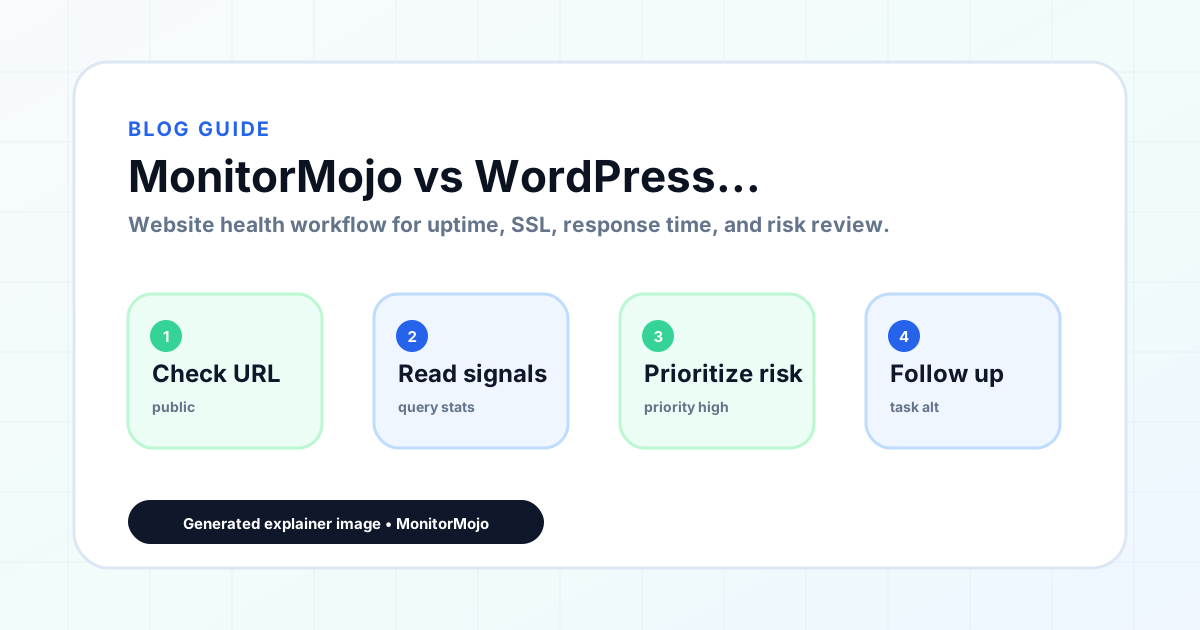
Step-by-step monitoring workflow
Start by listing the URLs that actually matter instead of just the homepage — for a WordPress care-plan provider reviewing client sites after a plugin update, that usually means the pages tied to revenue, signups, or trust, not every page on the site.
Next, define the check types for each URL: reachability, HTTP status, HTTPS/SSL certificate status and expiry window, response time, redirect behavior, and security header presence. For API, CLI, and AI-agent workflows, document which endpoint or command runs the check and where the result is stored.
Set a cadence that matches the risk — a low-traffic page may only need a monthly look, while a page tied to revenue or signups deserves a check after every deployment and before any campaign or launch.
Record what you find with a consistent format: URL, check type, status, issue, owner, detected date, and next review date. Then say what actually happened in plain language — a check can surface a symptom, but WordPress maintenance providers still need to confirm the cause.
- Choose the URLs that matter most to visitors, clients, revenue, and operations.
- Run uptime, SSL, response time, and security header checks on a consistent schedule.
- Triage failed or risky checks by likely owner: hosting, DNS, SSL, code, platform, or third party.
- Record notes in a repeatable format so future reviews do not start from scratch.
- Send a plain-language summary with the issue, impact, owner, and next review date.
- Run a confirmation check after remediation so there is an external result to reference.
Checklist or template
Use this template for recurring reviews: [URL], [Check Type], [Status], [Issue], [Priority], [Owner], [Detected Date], [Resolved Date], [Next Review Date]. Add a one-line summary at the top: what changed, what needs attention, and who owns the next step.
For WordPress maintenance providers, group findings into the four signals that matter most: reachability, SSL status, response time, and security headers. Where nothing needs action, say the check found no issue in that area rather than implying full coverage.
- [URL]: the exact page or endpoint checked.
- [Check Type]: uptime, SSL, response time, headers, API, CLI, or agent workflow.
- [Status]: pass, review, failed, blocked, or needs human investigation.
- [Issue]: the observable symptom, not an unsupported root-cause claim.
- [Owner]: agency, developer, host, DNS provider, client, or third-party vendor.
- [Next Review Date]: when the team should confirm status again.
Common mistakes
The most common mistake is monitoring only the homepage while a checkout, signup, or booking flow silently breaks. Another is assuming SSL auto-renewal always works — it can fail quietly, and an external check is the only way to catch that before a browser warning does.
For WordPress maintenance providers specifically, the recurring miss is treating one clean check as proof the whole site is fine, or fixing an issue without ever writing down what happened — which means the next person repeats the same investigation from zero.
- Tracking too many low-value URLs while missing the ones that matter.
- Skipping notes after an issue is resolved.
- Reporting a status without an owner or next step attached.
- Assuming automation can resolve an incident without human review.
- Treating one clean check as proof that every risk is covered.
Practical example
Consider a WordPress care-plan provider reviewing client sites after a plugin update. A scheduled check flags that a WordPress client site is slower than its usual baseline and that a security header is missing. Instead of guessing, the team logs the observation with a timestamp, assigns an owner, and re-checks after the fix ships — turning a vague "something feels off" into a specific, closed-loop task.
How MonitorMojo helps
MonitorMojo runs website health checks that combine reachability, SSL certificate status, response time, and security header presence in one workspace, so this workflow doesn't require stitching together several separate tools.
The API and CLI make the same checks scriptable for WordPress maintenance providers who want them wired into an existing process, while credit-based checks keep it practical to run reviews exactly when they matter — before a client call, after a deploy, or when someone asks whether a WordPress client site is healthy. Results still depend on hosting, DNS, and how quickly the responsible team acts on what the check finds.
Frequently Asked Questions
Do WordPress plugins like Jetpack provide website uptime monitoring?
Some WordPress plugins include a basic uptime monitoring component that pings the site from outside. However, these are generally less comprehensive than dedicated monitoring tools and still depend on the WordPress environment for internal monitoring. External checks from a dedicated tool give a more reliable external view.
Can I use MonitorMojo alongside a WordPress monitoring plugin?
Yes. MonitorMojo provides external health checks covering reachability, SSL, response time, security headers, and domain risk. WordPress monitoring plugins provide internal health signals about the WordPress installation. Using both gives a more complete picture than either provides alone.
Does MonitorMojo work with non-WordPress websites?
Yes. MonitorMojo checks any website URL regardless of the underlying platform — WordPress, Webflow, Squarespace, custom code, or anything else. The check tests the live site from outside the hosting environment.
What happens when WordPress goes down completely?
If WordPress returns a critical error, a blank page, or is entirely unreachable, WordPress monitoring plugins cannot report this because they are also offline. An external check tool sees the failure immediately because it tests from outside the WordPress installation.
Which is better for client reporting: plugins or external checks?
External checks are better for client reporting because they reflect what real visitors experience: reachability, HTTPS status, response time, and security headers. Internal WordPress monitoring data is useful for technical maintenance but less directly relevant to the client's question of 'is my website working correctly for my customers?'
Can this prevent every issue with a WordPress client site?
No. Monitoring helps WordPress maintenance providers detect website health signals and organize follow-up, but it does not prevent every outage, SSL issue, slow response, or third-party failure. The result still depends on hosting, DNS, infrastructure, and how quickly the responsible team investigates and responds.