MonitorMojo Blog
Website Monitoring for Agencies: Protect Client Sites and Deliver Better Care Plans
Running a web agency means being responsible for client websites you did not always build the hosting for. When a client site breaks on a Friday evening, someone finds out eventually — and the goal is for it to be you first. A structured website check workflow separates proactive service delivery from reactive damage control, and it gives you concrete proof that your care plan is doing its job. This expanded guide explains the practical monitoring workflow behind the topic, who should use it, what to check, how to document findings, and how to turn website health signals into useful client, developer, API, CLI, or AI-agent workflows without overstating what monitoring can prove.
Why agencies cannot rely on clients to notice problems
Most business owners do not check their own websites with any regularity. They browse their site when they want to show it to someone, or when a complaint arrives. A broken SSL certificate, a slow homepage, or a failed redirect can sit unnoticed for days before anyone says anything.
By the time a client messages you about a problem, the issue has already been live long enough to affect real visitors, damage search engine signals, and undermine the trust your agency has built. The conversation then shifts from how quickly it was fixed to why nobody noticed in the first place.
A structured website check workflow changes this dynamic. It puts you in a position to catch problems first, reach out proactively, and demonstrate that you are actively watching rather than waiting.
What agencies should monitor across client sites
A useful website health check covers more than just whether a homepage loads. For agencies managing client portfolios, the relevant signals include reachability, SSL certificate status, server response time, HTTP redirect behavior, security headers, and domain-related risk notes.
Each of these signals can fail independently. A server can be healthy while an SSL certificate expires. A homepage can load while checkout fails. A redirect can loop. Security headers can disappear after a platform migration. Checking only one dimension gives false confidence.
For agency use, the practical goal is a workflow that covers all the signals that can create client-facing problems — without requiring a dedicated operations engineer to interpret the results.
How monitoring supports website care plans
Care plans are easier to sell and retain when they deliver visible, ongoing value. Clients who never see proof of activity tend to cancel maintenance agreements when budgets get tight. Health check data gives you something concrete to show: reachability status, SSL expiry windows, response time snapshots, and a record of checks run during the billing period.
When something does go wrong, a monitoring workflow means you can document the issue, when you became aware, and what steps were taken to resolve it. That documentation makes client conversations easier and creates a record of the care plan's ongoing value.
Many agencies use MonitorMojo to build this check workflow into their client retainers — running site health checks regularly and using the results as the basis for monthly client reports.
The difference between hosting dashboards and website health checks
Hosting control panels show server-level metrics: CPU usage, disk space, and server process uptime. These are useful for infrastructure management but they do not tell you what a real visitor experiences when they load the client's website.
A server can report 100% uptime while the website itself returns a 500 error, redirects incorrectly, serves a broken page, or loads in eight seconds. Website health checks test the actual visitor experience from outside the hosting environment: reachability, status codes, SSL validity, and response time.
For agencies, both matter. Hosting dashboards help you manage infrastructure. Website health checks protect the visitor experience and catch the failures that clients actually notice and care about.
Scaling website checks across many client sites
Managing ten client websites is a fundamentally different challenge from managing one. The goal is not to manually open each hosting dashboard, but to have one view that shows which sites need attention right now.
As a portfolio grows, the administrative overhead of ad hoc checking becomes unsustainable. A useful agency monitoring workflow lets you add new client websites quickly, run checks efficiently, and review results without switching between multiple systems or logins.
MonitorMojo is built for this multi-site workflow. You can add client domains, run checks, review results in one dashboard, and use the output as the basis for client reporting — without needing a separate tool for each account.
Common website monitoring mistakes agencies make
One of the most common mistakes is checking only the homepage. The homepage can load perfectly while a checkout page times out, a client landing page returns an error, or a booking form fails silently. The pages that matter most to the client's revenue are often not the homepage.
Agencies also frequently rely on domain registrar renewal emails. These go to whoever registered the domain — often the client's personal email — and regularly get missed, treated as spam, or buried. SSL certificate expiry warnings have the same problem. Monitoring these signals independently is essential.
A third mistake is checking from your own browser on your own network. Local cache, authenticated sessions, and office DNS can make a broken site appear healthy. External website health checks test from outside your environment and give a closer approximation of what a real visitor sees.
What this workflow means
Website Monitoring for Agencies: Protect Client Sites and Deliver Better Care Plans is best understood as a repeatable website health workflow, not a promise that every outage or configuration issue will be avoided. Learn how web agencies use website health checks to catch downtime, SSL issues, and response problems before clients do — and how it supports profitable care plans.
In practice, this workflow centers on API, CLI, and AI-agent workflows that retrieve website health context with human review. Each check is planning input: it can show that a client's site is reachable, that a certificate has a given expiry window, that response time has shifted, or that a header is missing. It cannot prove root cause by itself or replace a human response. The value is in making the review consistent enough that web agencies and client-services teams can spot issues before someone downstream has to ask about them.
Who should use this
This is most useful for web agencies and client-services teams. Web design agencies managing ongoing client relationships and care plan retainers
Beyond that primary audience, the same checks are reusable by anyone with a public-facing URL that matters to revenue, leads, or reputation: a recurring review is cheap insurance compared to hearing about the problem from a client or customer first.
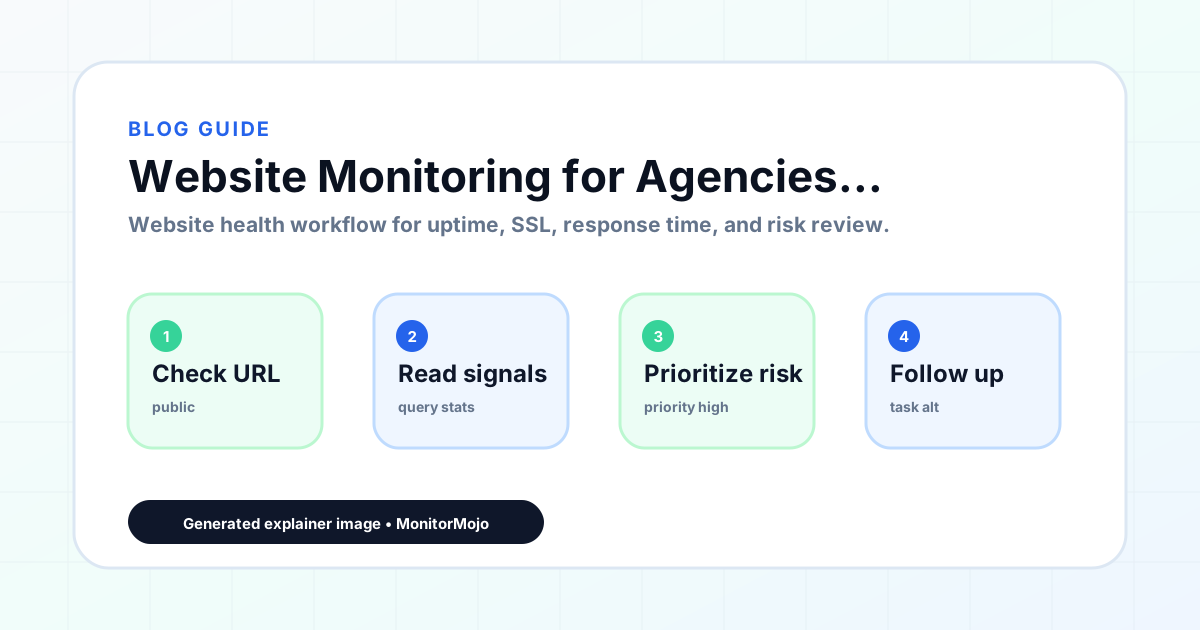
Step-by-step monitoring workflow
Start by listing the URLs that actually matter instead of just the homepage — for an agency reviewing a portfolio of client sites before a monthly report, that usually means the pages tied to revenue, signups, or trust, not every page on the site.
Next, define the check types for each URL: reachability, HTTP status, HTTPS/SSL certificate status and expiry window, response time, redirect behavior, and security header presence. For API, CLI, and AI-agent workflows, document which endpoint or command runs the check and where the result is stored.
Set a cadence that matches the risk — a low-traffic page may only need a monthly look, while a page tied to revenue or signups deserves a check after every deployment and before any campaign or launch.
Record what you find with a consistent format: URL, check type, status, issue, owner, detected date, and next review date. Then say what actually happened in plain language — a check can surface a symptom, but web agencies and client-services teams still need to confirm the cause.
- Choose the URLs that matter most to visitors, clients, revenue, and operations.
- Run uptime, SSL, response time, and security header checks on a consistent schedule.
- Triage failed or risky checks by likely owner: hosting, DNS, SSL, code, platform, or third party.
- Record notes in a repeatable format so future reviews do not start from scratch.
- Send a plain-language summary with the issue, impact, owner, and next review date.
- Run a confirmation check after remediation so there is an external result to reference.
Checklist or template
Use this template for recurring reviews: [URL], [Check Type], [Status], [Issue], [Priority], [Owner], [Detected Date], [Resolved Date], [Next Review Date]. Add a one-line summary at the top: what changed, what needs attention, and who owns the next step.
For web agencies and client-services teams, group findings into the four signals that matter most: reachability, SSL status, response time, and security headers. Where nothing needs action, say the check found no issue in that area rather than implying full coverage.
- [URL]: the exact page or endpoint checked.
- [Check Type]: uptime, SSL, response time, headers, API, CLI, or agent workflow.
- [Status]: pass, review, failed, blocked, or needs human investigation.
- [Issue]: the observable symptom, not an unsupported root-cause claim.
- [Owner]: agency, developer, host, DNS provider, client, or third-party vendor.
- [Next Review Date]: when the team should confirm status again.
Common mistakes
The most common mistake is monitoring only the homepage while a checkout, signup, or booking flow silently breaks. Another is assuming SSL auto-renewal always works — it can fail quietly, and an external check is the only way to catch that before a browser warning does.
For web agencies and client-services teams specifically, the recurring miss is treating one clean check as proof the whole site is fine, or fixing an issue without ever writing down what happened — which means the next person repeats the same investigation from zero.
- Tracking too many low-value URLs while missing the ones that matter.
- Skipping notes after an issue is resolved.
- Reporting a status without an owner or next step attached.
- Assuming automation can resolve an incident without human review.
- Treating one clean check as proof that every risk is covered.
Practical example
Consider an agency reviewing a portfolio of client sites before a monthly report. A scheduled check flags that a client's site is slower than its usual baseline and that a security header is missing. Instead of guessing, the team logs the observation with a timestamp, assigns an owner, and re-checks after the fix ships — turning a vague "something feels off" into a specific, closed-loop task.
How MonitorMojo helps
MonitorMojo runs website health checks that combine reachability, SSL certificate status, response time, and security header presence in one workspace, so this workflow doesn't require stitching together several separate tools.
The API and CLI make the same checks scriptable for web agencies and client-services teams who want them wired into an existing process, while credit-based checks keep it practical to run reviews exactly when they matter — before a client call, after a deploy, or when someone asks whether a client's site is healthy. Results still depend on hosting, DNS, and how quickly the responsible team acts on what the check finds.
Who this is for
- Web design agencies managing ongoing client relationships and care plan retainers
- WordPress maintenance providers delivering monthly site health services
- Digital agencies that include hosting or site health in client contracts
- Marketing agencies responsible for client landing pages and campaign sites
- IT consultants managing website portfolios for small and mid-size businesses
Frequently Asked Questions
How often should agencies run website health checks?
Many agencies run checks before client calls, at the start of monthly retainers, after deployments, and after platform or hosting migrations. For active care plan clients, a weekly check workflow is common. The right cadence depends on how active each site is and what the care plan promises.
Can I check multiple client websites from one place?
Yes. MonitorMojo supports multi-site use. You can add multiple client domains, run checks, and review results in one dashboard without needing a separate tool or login for each client site.
What should an agency website care plan include?
A solid care plan typically covers: hosting management, software and plugin updates, SSL and domain monitoring, regular backups, performance checks, security reviews, and a monthly health report. MonitorMojo helps agencies deliver on the monitoring and reporting parts of that service.
How do I explain website monitoring to clients who are not technical?
Frame it as having someone watch the site so problems are caught before customers notice. Clients do not need to understand the technical details — they need to know that the service means fewer surprises and faster responses when something breaks.
What is the difference between uptime monitoring and website health checks?
Uptime monitoring traditionally checks whether a server responds at all — a simple ping or availability test. Website health checks are broader: reachability, SSL certificate status, response time, security headers, and domain risk signals. For agencies, website health checks give a more complete picture of what clients and visitors actually experience.
Can this prevent every issue with a client's site?
No. Monitoring helps web agencies and client-services teams detect website health signals and organize follow-up, but it does not prevent every outage, SSL issue, slow response, or third-party failure. The result still depends on hosting, DNS, infrastructure, and how quickly the responsible team investigates and responds.