MonitorMojo Blog
Best Tools to Create Website Health Reports
Website health reports turn the invisible work of monitoring into something clients and stakeholders can see, understand, and value. The best reporting tools generate check data automatically, support client reporting workflows, and make website health visible without requiring manual data collection. This guide compares the leading options. This expanded guide explains the practical monitoring workflow behind the topic, who should use it, what to check, how to document findings, and how to turn website health signals into useful client, developer, API, CLI, or AI-agent workflows without overstating what monitoring can prove.
What website health reporting requires
A website health report should communicate: is the site healthy right now, did anything happen this period that the client should know about, and is there anything coming up that requires action.
The data should come from actual health checks, not manual observations. Automated check data is more reliable and defensible than subjective assessments.
The report should be producible efficiently. A template-based approach with data populated from health checks is more scalable than writing each report from scratch.
MonitorMojo for website health reporting
MonitorMojo provides the check data that forms the foundation of website health reports. Each check returns reachability, SSL validity, response time, redirect behavior, security headers, and domain risk notes.
The multi-site dashboard lets you review health status across all monitored sites. Check results can be referenced directly in reports without manual reformatting.
For agencies, running checks before monthly client calls provides current data to reference. Including check results in reports makes the monitoring work visible. The results depend on hosting, DNS, infrastructure, configuration, traffic, and response process.
Other website health reporting tools
StatusCake provides monitoring data that can be included in reports, with multi-site dashboards and API access for data retrieval.
Oh Dear provides detailed technical monitoring data suitable for technical reports. Its European hosting may be relevant for EU-based agencies.
Google Lighthouse provides page-level performance, accessibility, and best practices reports. It is useful for detailed page analysis but does not provide portfolio-level health reporting.
Custom reporting tools and templates can be built using monitoring API data. This approach provides maximum flexibility but requires development effort.
Choosing the right health reporting approach
For agencies that need check data that can be directly included in client reports, MonitorMojo provides clear, communicable results.
For detailed technical reports, combining monitoring data with tools like Google Lighthouse provides comprehensive coverage.
The key is having reliable check data that forms the foundation of every report, rather than relying on manual observations.
What this workflow means
Best Tools to Create Website Health Reports is best understood as a repeatable website health workflow, not a promise that every outage or configuration issue will be avoided. Compare the best tools for creating website health reports. Find tools that generate check data, support client reporting workflows, and make website health visible to stakeholders.
In practice, this workflow centers on agency reporting, client communication, portfolio review, and repeatable maintenance workflows. Each check is planning input: it can show that the site is reachable, that a certificate has a given expiry window, that response time has shifted, or that a header is missing. It cannot prove root cause by itself or replace a human response. The value is in making the review consistent enough that site owners and small teams can spot issues before someone downstream has to ask about them.
Who should use this
This is most useful for site owners and small teams. Agencies delivering monthly client health reports
Beyond that primary audience, the same checks are reusable by anyone with a public-facing URL that matters to revenue, leads, or reputation: a recurring review is cheap insurance compared to hearing about the problem from a client or customer first.
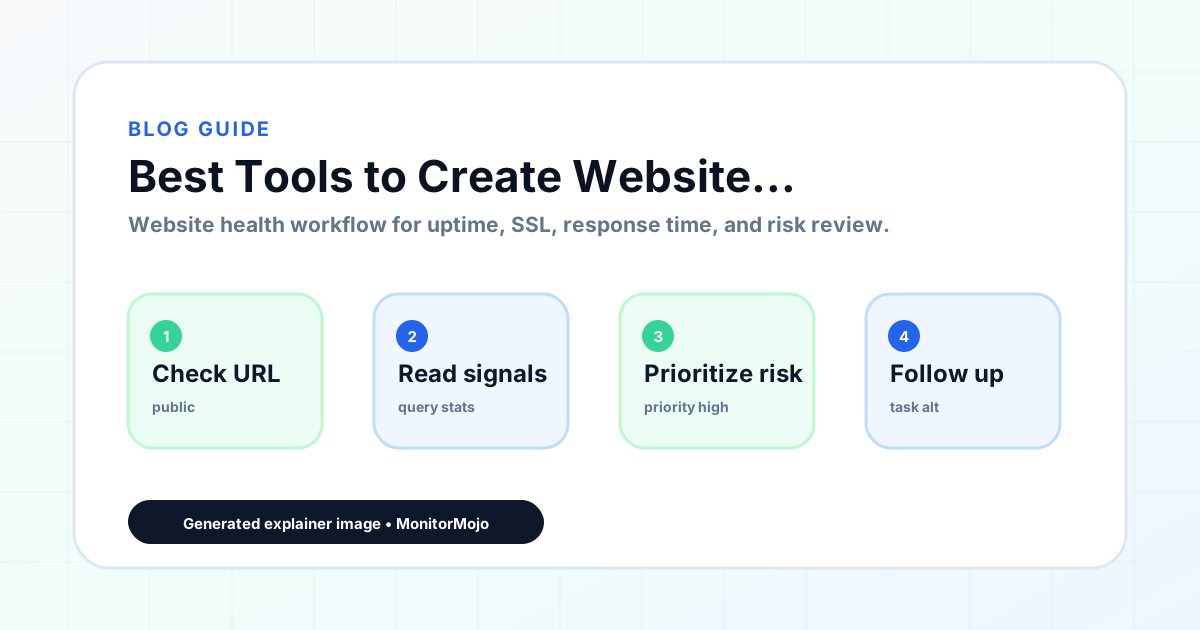
Step-by-step monitoring workflow
Start by listing the URLs that actually matter instead of just the homepage — for a small team doing a routine check before something breaks in front of a visitor, that usually means the pages tied to revenue, signups, or trust, not every page on the site.
Next, define the check types for each URL: reachability, HTTP status, HTTPS/SSL certificate status and expiry window, response time, redirect behavior, and security header presence. For API, CLI, and AI-agent workflows, document which endpoint or command runs the check and where the result is stored.
Set a cadence that matches the risk — a low-traffic page may only need a monthly look, while a page tied to revenue or signups deserves a check after every deployment and before any campaign or launch.
Record what you find with a consistent format: URL, check type, status, issue, owner, detected date, and next review date. Then say what actually happened in plain language — a check can surface a symptom, but site owners and small teams still need to confirm the cause.
- Choose the URLs that matter most to visitors, clients, revenue, and operations.
- Run uptime, SSL, response time, and security header checks on a consistent schedule.
- Triage failed or risky checks by likely owner: hosting, DNS, SSL, code, platform, or third party.
- Record notes in a repeatable format so future reviews do not start from scratch.
- Send a plain-language summary with the issue, impact, owner, and next review date.
- Run a confirmation check after remediation so there is an external result to reference.
Checklist or template
Use this template for recurring reviews: [URL], [Check Type], [Status], [Issue], [Priority], [Owner], [Detected Date], [Resolved Date], [Next Review Date]. Add a one-line summary at the top: what changed, what needs attention, and who owns the next step.
For site owners and small teams, group findings into the four signals that matter most: reachability, SSL status, response time, and security headers. Where nothing needs action, say the check found no issue in that area rather than implying full coverage.
- [URL]: the exact page or endpoint checked.
- [Check Type]: uptime, SSL, response time, headers, API, CLI, or agent workflow.
- [Status]: pass, review, failed, blocked, or needs human investigation.
- [Issue]: the observable symptom, not an unsupported root-cause claim.
- [Owner]: agency, developer, host, DNS provider, client, or third-party vendor.
- [Next Review Date]: when the team should confirm status again.
Common mistakes
The most common mistake is monitoring only the homepage while a checkout, signup, or booking flow silently breaks. Another is assuming SSL auto-renewal always works — it can fail quietly, and an external check is the only way to catch that before a browser warning does.
For site owners and small teams specifically, the recurring miss is treating one clean check as proof the whole site is fine, or fixing an issue without ever writing down what happened — which means the next person repeats the same investigation from zero.
- Tracking too many low-value URLs while missing the ones that matter.
- Skipping notes after an issue is resolved.
- Reporting a status without an owner or next step attached.
- Assuming automation can resolve an incident without human review.
- Treating one clean check as proof that every risk is covered.
Practical example
Consider a small team doing a routine check before something breaks in front of a visitor. A scheduled check flags that the site is slower than its usual baseline and that a security header is missing. Instead of guessing, the team logs the observation with a timestamp, assigns an owner, and re-checks after the fix ships — turning a vague "something feels off" into a specific, closed-loop task.
How MonitorMojo helps
MonitorMojo runs website health checks that combine reachability, SSL certificate status, response time, and security header presence in one workspace, so this workflow doesn't require stitching together several separate tools.
The API and CLI make the same checks scriptable for site owners and small teams who want them wired into an existing process, while credit-based checks keep it practical to run reviews exactly when they matter — before a client call, after a deploy, or when someone asks whether the site is healthy. Results still depend on hosting, DNS, and how quickly the responsible team acts on what the check finds.
Who this is for
- Agencies delivering monthly client health reports
- Freelancers making their monitoring work visible to clients
- WordPress maintenance providers building reporting workflows
- Anyone responsible for communicating website health to non-technical stakeholders
Frequently Asked Questions
What is the best tool for creating website health reports?
MonitorMojo provides check data that forms the foundation of health reports. Check results are designed to be communicable to clients and can be included directly in reports.
How often should I generate website health reports?
Monthly is standard for care plan clients. Weekly status emails can supplement monthly reports for clients who want more visibility.
What should a website health report include?
Reachability status, SSL certificate validity and expiry, response time snapshot, security header status, any issues found and resolved, and upcoming items requiring attention.
Can I automate report generation?
MonitorMojo's API enables automated data retrieval for report generation. You can build templates that pull check data automatically.
How do I make health reports valuable to clients?
Include specific findings and actions taken. A report that documents issues caught and resolved demonstrates the monitoring's value more effectively than a report showing all green.
Can this prevent every issue with the site?
No. Monitoring helps site owners and small teams detect website health signals and organize follow-up, but it does not prevent every outage, SSL issue, slow response, or third-party failure. The result still depends on hosting, DNS, infrastructure, and how quickly the responsible team investigates and responds.