MonitorMojo Blog
Website Health Check: What It Covers and How to Run One
A website health check is a structured review of the key signals that determine whether a website is working correctly for visitors. Unlike a single metric check — just testing whether a site loads, or just checking SSL status — a health check combines multiple signals into one view: reachability, HTTPS and certificate status, server response time, security headers, and domain-related risk notes. Run regularly, it is one of the most practical ways to catch website problems before they affect visitors, clients, or revenue. This expanded guide explains the practical monitoring workflow behind the topic, who should use it, what to check, how to document findings, and how to turn website health signals into useful client, developer, API, CLI, or AI-agent workflows without overstating what monitoring can prove.
What a website health check covers
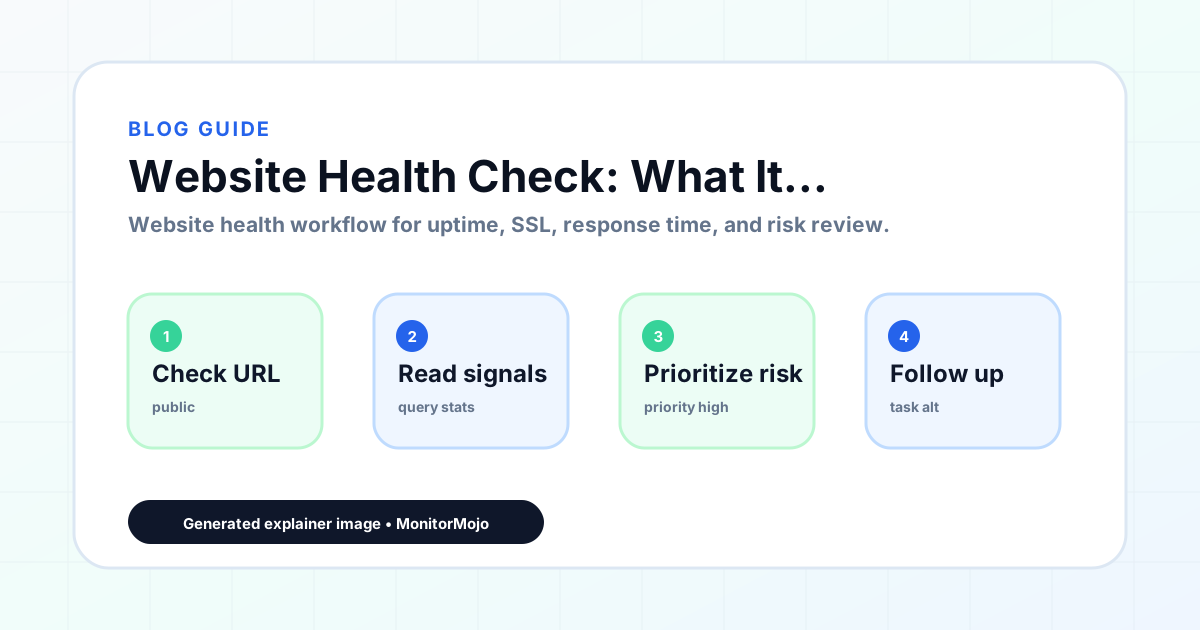
A complete website health check covers the signals that most directly affect visitor experience and website reliability. The core signals are: reachability (does the site respond at all), HTTP status code (is the server returning a success response, or an error), HTTPS status (is the SSL certificate valid and not close to expiring), response time (how long the server takes to respond), security headers (are key browser protections in place), and domain risk notes (are there any signals related to domain registration or DNS that could affect availability).
Each of these signals can cause a real problem independently. A site can be reachable but serving a 404. An HTTPS site can be reachable but have an SSL certificate expiring in five days. A site can pass all of the above but respond slowly enough to drive visitors away. A check that covers all of these signals together gives you a complete picture rather than a false one.
For practical use, the goal is a check that is fast enough to run regularly and clear enough that a non-technical person can understand and act on the results without interpretation.
When to run a website health check
The most common occasions to run a website health check are: on a regular schedule (monthly for most sites, weekly for actively managed sites), after any significant website change (new plugin, theme update, content migration, hosting change), before an important business event (product launch, campaign, high-traffic period), and after receiving any report from a customer or client that something seems wrong.
For agencies, a health check before client calls or monthly reporting periods serves multiple purposes. It gives you current data to reference, it occasionally surfaces an issue you can address proactively rather than reactively, and it demonstrates that the site is actively reviewed as part of the care plan.
Running a check after a website change is particularly important. Migrations, hosting changes, and major updates are the most common moments when redirects break, SSL certificates get dropped, security headers disappear, or response time degrades significantly.
How to run a basic website health check
The simplest approach is to use a dedicated website health check tool that handles the full range of signals in one request. Enter the domain, run the check, and review the results. This takes less time than logging into individual hosting dashboards, checking SSL expiry calendars, and running separate response time tests.
For each signal, the result falls into one of a few categories: healthy (no action needed), needs attention (worth reviewing or addressing soon), or requires immediate action (something is already broken or imminently about to fail). This kind of clear output is more useful than raw technical data that requires interpretation.
MonitorMojo runs a real server-side check on the URL you provide, checking reachability, SSL certificate status and expiry, response time, security headers, and domain risk signals. The results show which signals are healthy and which need attention, with the context needed to decide what to do next.
What to do with health check results
A health check result is a starting point for action, not a complete diagnosis. When a signal flags as needing attention, the next step is to investigate that specific area. An SSL expiry warning means initiating the renewal process. A slow response time means checking hosting resources or recent site changes. A missing security header means adding it through the appropriate configuration layer.
Not every finding requires immediate action. A certificate with 30 days remaining is not an emergency, but it is worth scheduling the renewal. A response time of 600ms is not ideal, but it is not causing immediate failures. The health check gives you prioritized information — what is broken now versus what needs attention in the next week or month.
For agencies, health check results are also useful as client communication. A monthly report that summarizes health check findings — what was reviewed, what was healthy, and what was addressed — turns an invisible maintenance service into a visible one. Clients who can see the work being done are more likely to continue the engagement.
Building a health check routine
The value of website health checks comes from running them consistently. A single check tells you about today. A series of checks over time tells you whether things are getting better, staying stable, or slowly degrading. It also creates a paper trail of due diligence — useful for agencies who need to demonstrate that monitoring was active.
For most teams, a monthly health check routine is practical to maintain. Pick a fixed time — the first Monday of the month, the last day of the billing period, the day before a client call — and run checks on all the sites in your portfolio. Document the results. Act on findings. Repeat.
For more active sites or sites that have recently had issues, a weekly cadence makes sense. For sites that have just undergone a significant change, run a check immediately after the change and again 24 to 48 hours later to confirm stability.
The difference between a health check and full monitoring
A website health check is a point-in-time review — you run it, see results, and take action. This is different from continuous monitoring infrastructure that watches a site around the clock and sends automated alerts when something changes.
For many small businesses, agencies, and freelancers, a regular health check workflow is the right fit. It provides meaningful visibility without the cost and complexity of continuous monitoring infrastructure. The question is not whether to have comprehensive visibility — it is whether the frequency and automation level matches the team's actual capacity to respond.
MonitorMojo is designed for practical website health checks rather than enterprise infrastructure monitoring. It fits teams who want a structured, regular review of their key sites without the overhead of setting up and maintaining a full monitoring stack.
What this workflow means
Website Health Check: What It Covers and How to Run One is best understood as a repeatable website health workflow, not a promise that every outage or configuration issue will be avoided. Learn what a website health check covers — reachability, SSL, response time, security headers, and domain risk — and how to make it a regular part of your site management workflow.
In practice, this workflow centers on uptime, SSL certificates, response time, security headers, website health summaries, and monthly review notes. Each check is planning input: it can show that the site is reachable, that a certificate has a given expiry window, that response time has shifted, or that a header is missing. It cannot prove root cause by itself or replace a human response. The value is in making the review consistent enough that site owners and small teams can spot issues before someone downstream has to ask about them.
Who should use this
This is most useful for site owners and small teams. The common thread is a small team doing a routine check before something breaks in front of a visitor, where a missed signal costs more than the few minutes it takes to check.
Beyond that primary audience, the same checks are reusable by anyone with a public-facing URL that matters to revenue, leads, or reputation: a recurring review is cheap insurance compared to hearing about the problem from a client or customer first.
Step-by-step monitoring workflow
Start by listing the URLs that actually matter instead of just the homepage — for a small team doing a routine check before something breaks in front of a visitor, that usually means the pages tied to revenue, signups, or trust, not every page on the site.
Next, define the check types for each URL: reachability, HTTP status, HTTPS/SSL certificate status and expiry window, response time, redirect behavior, and security header presence. For API, CLI, and AI-agent workflows, document which endpoint or command runs the check and where the result is stored.
Set a cadence that matches the risk — a low-traffic page may only need a monthly look, while a page tied to revenue or signups deserves a check after every deployment and before any campaign or launch.
Record what you find with a consistent format: URL, check type, status, issue, owner, detected date, and next review date. Then say what actually happened in plain language — a check can surface a symptom, but site owners and small teams still need to confirm the cause.
- Choose the URLs that matter most to visitors, clients, revenue, and operations.
- Run uptime, SSL, response time, and security header checks on a consistent schedule.
- Triage failed or risky checks by likely owner: hosting, DNS, SSL, code, platform, or third party.
- Record notes in a repeatable format so future reviews do not start from scratch.
- Send a plain-language summary with the issue, impact, owner, and next review date.
- Run a confirmation check after remediation so there is an external result to reference.
Checklist or template
Use this template for recurring reviews: [URL], [Check Type], [Status], [Issue], [Priority], [Owner], [Detected Date], [Resolved Date], [Next Review Date]. Add a one-line summary at the top: what changed, what needs attention, and who owns the next step.
For site owners and small teams, group findings into the four signals that matter most: reachability, SSL status, response time, and security headers. Where nothing needs action, say the check found no issue in that area rather than implying full coverage.
- [URL]: the exact page or endpoint checked.
- [Check Type]: uptime, SSL, response time, headers, API, CLI, or agent workflow.
- [Status]: pass, review, failed, blocked, or needs human investigation.
- [Issue]: the observable symptom, not an unsupported root-cause claim.
- [Owner]: agency, developer, host, DNS provider, client, or third-party vendor.
- [Next Review Date]: when the team should confirm status again.
Common mistakes
The most common mistake is monitoring only the homepage while a checkout, signup, or booking flow silently breaks. Another is assuming SSL auto-renewal always works — it can fail quietly, and an external check is the only way to catch that before a browser warning does.
For site owners and small teams specifically, the recurring miss is treating one clean check as proof the whole site is fine, or fixing an issue without ever writing down what happened — which means the next person repeats the same investigation from zero.
- Tracking too many low-value URLs while missing the ones that matter.
- Skipping notes after an issue is resolved.
- Reporting a status without an owner or next step attached.
- Assuming automation can resolve an incident without human review.
- Treating one clean check as proof that every risk is covered.
Practical example
Consider a small team doing a routine check before something breaks in front of a visitor. A scheduled check flags that the site is slower than its usual baseline and that a security header is missing. Instead of guessing, the team logs the observation with a timestamp, assigns an owner, and re-checks after the fix ships — turning a vague "something feels off" into a specific, closed-loop task.
How MonitorMojo helps
MonitorMojo runs website health checks that combine reachability, SSL certificate status, response time, and security header presence in one workspace, so this workflow doesn't require stitching together several separate tools.
The API and CLI make the same checks scriptable for site owners and small teams who want them wired into an existing process, while credit-based checks keep it practical to run reviews exactly when they matter — before a client call, after a deploy, or when someone asks whether the site is healthy. Results still depend on hosting, DNS, and how quickly the responsible team acts on what the check finds.
Frequently Asked Questions
How long does a website health check take?
A single website health check in MonitorMojo takes a few seconds to run. Reviewing the results for a single site takes a minute or two. For a portfolio of ten client sites, a monthly health check review typically takes under 30 minutes in total.
What is the difference between a website health check and a website audit?
A website health check focuses on technical availability and reliability signals: reachability, SSL, response time, security headers, and domain risk. A website audit is typically broader — it may cover SEO analysis, content evaluation, design review, and conversion optimization. Both are useful but serve different purposes.
Do I need to be technical to run a website health check?
No. MonitorMojo is designed to give clear, actionable results that any website owner or manager can understand. You enter a URL, run the check, and see what needs attention without needing to interpret raw server logs or configuration files.
What should a website health check report include?
A useful health check report includes: reachability status, SSL certificate validity and expiry window, server response time, security header presence, domain risk signals, a summary of what needs attention, and recommended next steps. MonitorMojo produces check results that can be used as the basis for this kind of client report.
How is a website health check different from just loading the page in a browser?
Loading a page in your browser uses your local cache, your personal network connection, and your browser's authentication state. It does not check SSL expiry dates, security headers, or domain risk signals. An external website health check tests from outside your environment, gives objective response data, and surfaces the technical signals that affect all visitors — not just your personal experience of the site.
Can this prevent every issue with the site?
No. Monitoring helps site owners and small teams detect website health signals and organize follow-up, but it does not prevent every outage, SSL issue, slow response, or third-party failure. The result still depends on hosting, DNS, infrastructure, and how quickly the responsible team investigates and responds.