MonitorMojo Blog
Agency Website Care Plan Checklist: Set Up, Deliver, and Report
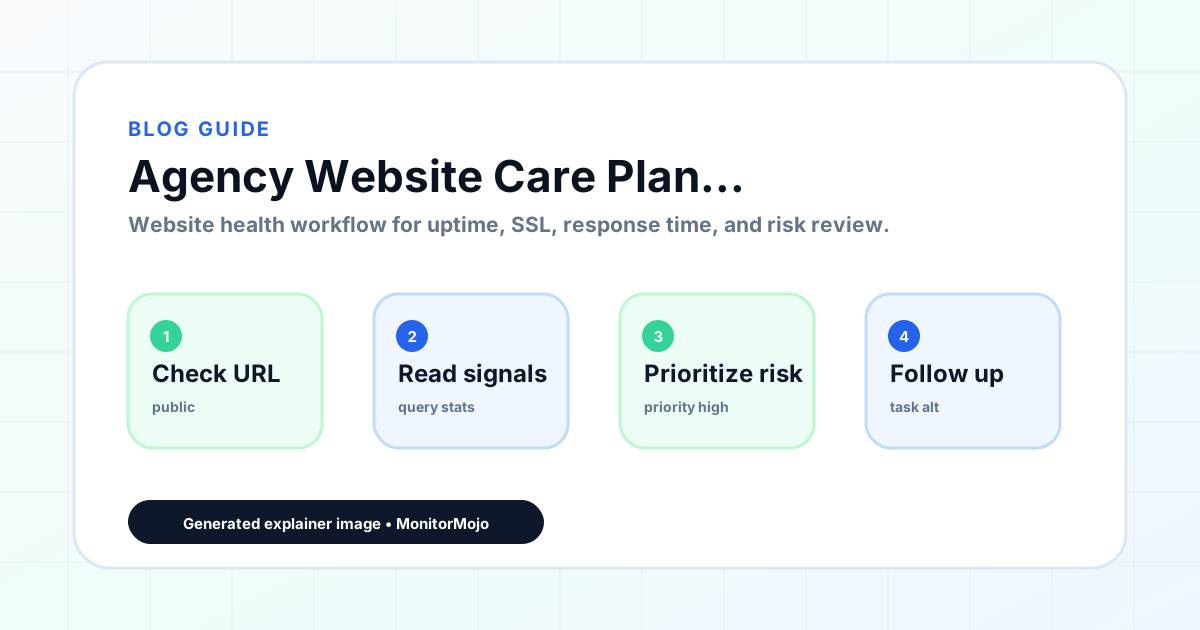
A website care plan is only as good as the process behind it. Without a consistent delivery process, care plans become reactive support agreements rather than proactive maintenance services — and clients who feel like they are only getting value when something breaks tend to cancel. This checklist covers what a care plan setup and delivery process looks like: from client onboarding to monthly delivery to reporting, with the monitoring workflow that makes the service visible and defensible. This expanded guide explains the practical monitoring workflow behind the topic, who should use it, what to check, how to document findings, and how to turn website health signals into useful client, developer, API, CLI, or AI-agent workflows without overstating what monitoring can prove.
Care plan onboarding checklist
Onboarding a new care plan client is when you establish the foundation for everything that follows. Get the access you need, document the site's current state, and set clear expectations before the first delivery month begins. A thorough onboarding prevents the 'we have always had this issue' problem that arises when something is discovered mid-care-plan and the client thinks it is new.
Run an initial website health check as part of onboarding. This establishes the baseline state of the site: reachability, SSL certificate validity and expiry date, response time, security headers, and any domain risk signals. Document anything that needs attention before the first month of service begins so the care plan scope is clear.
Get clear ownership documentation for domain registrar and hosting provider access. Who manages the domain? Who manages hosting? What email addresses are on file for renewal notifications? These details matter when something expires or an access issue arises.
- Access obtained for all necessary hosting, domain, and CMS accounts
- Initial website health check completed and documented
- SSL certificate expiry date recorded in client file
- Domain registration expiry date recorded in client file
- Backup system confirmed working with retention policy documented
- Current plugin and CMS versions documented
- Care plan scope agreed and documented
- Monthly reporting format and delivery date agreed with client
Monthly delivery checklist
A monthly care plan delivery should follow the same process each month. This creates consistency, reduces the cognitive load of figuring out what to do each month, and makes it easy to onboard team members into the delivery workflow. If the monthly process is documented as a checklist, anyone on the team can deliver a care plan month consistently.
The core delivery items — software updates, backup verification, health check, security review — should be completed within a defined window each month so the client report is sent on a consistent date. Clients who receive a report at the same time each month come to expect and value it. Clients who receive irregular updates feel uncertain about whether the service is active.
Document what was completed, what was found, and what was addressed during each delivery period. This documentation serves multiple purposes: it gives you a basis for the client report, it creates a record of care plan delivery for dispute resolution if needed, and it reveals patterns across delivery periods that inform recommendations.
- CMS, theme, and plugin updates applied and tested
- Backup completed and backup success confirmed
- Website health check run and results documented
- SSL certificate expiry checked
- Domain expiry checked
- Security header check completed
- Response time compared to previous month
- Any issues from last month confirmed resolved
- Client report prepared
- Report sent on agreed delivery date
Website health check in care plan delivery
The website health check is the technical foundation of care plan reporting. It provides objective, current data on the signals that matter most to clients: is the site up, is HTTPS working, how fast is it responding, are security protections in place, is the domain healthy. No amount of plugin updates makes a care plan feel complete to a client if the site is slow or the SSL certificate is about to expire.
Run the health check before and after applying updates so you have both a baseline and a post-maintenance snapshot. If something changes unexpectedly after an update, the pre-update baseline helps you identify what changed and when.
Use MonitorMojo to run a combined health check that covers reachability, SSL, response time, security headers, and domain risk signals in one workflow. The results can be summarized directly into the client report format your team uses.
- Pre-maintenance health check run and results recorded
- Post-maintenance health check run and compared to pre-maintenance
- Any health check findings documented with recommended action
- SSL expiry date updated in client record after any renewal
- Domain expiry date updated in client record if changed
Client reporting checklist
The client report is what makes the care plan visible to the client. Without it, the client pays a monthly fee and receives a website that works — which is what they expected. With a clear monthly report, the client pays a monthly fee and sees the specific work that was done to keep their site working.
A good care plan report is brief but complete. It does not need to list every plugin version update or every backup file. It needs to answer the client's implicit question: 'was anyone watching my site this month, and is it in good shape?' The answer should be: yes, we reviewed it, here is what we found, here is what we did, and here is the current status.
Customize the report format for each client's technical comfort level. A developer client might want specific version numbers and response time data. A local business owner wants to know their site is healthy and their certificate is not expiring next month. Both are valid — the underlying data is the same; the presentation level is different.
- Report includes month, client name, and review date
- Health check summary included (reachability, SSL, response time)
- SSL certificate expiry date and days remaining included
- Domain expiry date included if relevant
- Updates applied during the month listed
- Any issues found and resolved summarized
- Any items requiring client action clearly noted
- Report delivered on agreed date
What this workflow means
Agency Website Care Plan Checklist: Set Up, Deliver, and Report is best understood as a repeatable website health workflow, not a promise that every outage or configuration issue will be avoided. A practical checklist for agencies setting up and delivering website care plans — covering onboarding, monthly delivery, health checks, and client reporting.
In practice, this workflow centers on agency reporting, client communication, portfolio review, and repeatable maintenance workflows. Each check is planning input: it can show that a client's site is reachable, that a certificate has a given expiry window, that response time has shifted, or that a header is missing. It cannot prove root cause by itself or replace a human response. The value is in making the review consistent enough that web agencies and client-services teams can spot issues before someone downstream has to ask about them.
Who should use this
This is most useful for web agencies and client-services teams. Web agencies setting up or refining their website care plan delivery process
Beyond that primary audience, the same checks are reusable by anyone with a public-facing URL that matters to revenue, leads, or reputation: a recurring review is cheap insurance compared to hearing about the problem from a client or customer first.
Step-by-step monitoring workflow
Start by listing the URLs that actually matter instead of just the homepage — for an agency reviewing a portfolio of client sites before a monthly report, that usually means the pages tied to revenue, signups, or trust, not every page on the site.
Next, define the check types for each URL: reachability, HTTP status, HTTPS/SSL certificate status and expiry window, response time, redirect behavior, and security header presence. For API, CLI, and AI-agent workflows, document which endpoint or command runs the check and where the result is stored.
Set a cadence that matches the risk — a low-traffic page may only need a monthly look, while a page tied to revenue or signups deserves a check after every deployment and before any campaign or launch.
Record what you find with a consistent format: URL, check type, status, issue, owner, detected date, and next review date. Then say what actually happened in plain language — a check can surface a symptom, but web agencies and client-services teams still need to confirm the cause.
- Choose the URLs that matter most to visitors, clients, revenue, and operations.
- Run uptime, SSL, response time, and security header checks on a consistent schedule.
- Triage failed or risky checks by likely owner: hosting, DNS, SSL, code, platform, or third party.
- Record notes in a repeatable format so future reviews do not start from scratch.
- Send a plain-language summary with the issue, impact, owner, and next review date.
- Run a confirmation check after remediation so there is an external result to reference.
Checklist or template
Use this template for recurring reviews: [URL], [Check Type], [Status], [Issue], [Priority], [Owner], [Detected Date], [Resolved Date], [Next Review Date]. Add a one-line summary at the top: what changed, what needs attention, and who owns the next step.
For web agencies and client-services teams, group findings into the four signals that matter most: reachability, SSL status, response time, and security headers. Where nothing needs action, say the check found no issue in that area rather than implying full coverage.
- [URL]: the exact page or endpoint checked.
- [Check Type]: uptime, SSL, response time, headers, API, CLI, or agent workflow.
- [Status]: pass, review, failed, blocked, or needs human investigation.
- [Issue]: the observable symptom, not an unsupported root-cause claim.
- [Owner]: agency, developer, host, DNS provider, client, or third-party vendor.
- [Next Review Date]: when the team should confirm status again.
Common mistakes
The most common mistake is monitoring only the homepage while a checkout, signup, or booking flow silently breaks. Another is assuming SSL auto-renewal always works — it can fail quietly, and an external check is the only way to catch that before a browser warning does.
For web agencies and client-services teams specifically, the recurring miss is treating one clean check as proof the whole site is fine, or fixing an issue without ever writing down what happened — which means the next person repeats the same investigation from zero.
- Tracking too many low-value URLs while missing the ones that matter.
- Skipping notes after an issue is resolved.
- Reporting a status without an owner or next step attached.
- Assuming automation can resolve an incident without human review.
- Treating one clean check as proof that every risk is covered.
Practical example
Consider an agency reviewing a portfolio of client sites before a monthly report. A scheduled check flags that a client's site is slower than its usual baseline and that a security header is missing. Instead of guessing, the team logs the observation with a timestamp, assigns an owner, and re-checks after the fix ships — turning a vague "something feels off" into a specific, closed-loop task.
How MonitorMojo helps
MonitorMojo runs website health checks that combine reachability, SSL certificate status, response time, and security header presence in one workspace, so this workflow doesn't require stitching together several separate tools.
The API and CLI make the same checks scriptable for web agencies and client-services teams who want them wired into an existing process, while credit-based checks keep it practical to run reviews exactly when they matter — before a client call, after a deploy, or when someone asks whether a client's site is healthy. Results still depend on hosting, DNS, and how quickly the responsible team acts on what the check finds.
Who this is for
- Web agencies setting up or refining their website care plan delivery process
- Freelancers who want to formalize their client maintenance workflow
- WordPress maintenance providers building consistent monthly delivery processes
- Digital agencies adding care plans to their service offering for the first time
- Any team that manages client websites on a recurring maintenance basis
Frequently Asked Questions
What is the minimum a care plan should include?
At minimum: software and plugin updates, verified backups, and a website health check covering SSL and domain expiry. These three cover the most common causes of site failure and the most common client complaints. Anything beyond this — security reviews, performance optimization, content updates — is an add-on to the base service.
How should I price a website care plan?
Price based on the time it takes to deliver the plan consistently, plus the tools and overhead costs involved. Most freelancers and agencies price basic care plans at $50 to $150 per month per site. Higher-tier plans with more frequent monitoring, faster response SLAs, or additional services like performance optimization are priced higher. Check what similar providers in your market charge as a reference point.
How do I handle a client whose site has serious problems at onboarding?
Document the existing issues clearly before the care plan begins. Agree on which issues are pre-existing and which will be addressed as part of the care plan or as a separate project. Do not start the care plan clock on a site with unresolved issues — address them first or exclude them explicitly from the care plan scope.
What does MonitorMojo contribute to care plan delivery?
MonitorMojo provides the website health check layer of care plan delivery: combined reachability, SSL, response time, security headers, and domain risk signals in one check. The results serve as the technical foundation for client reports and give you objective data on site health that the client can see and understand.
How do I handle a month where nothing changed?
Send the report anyway. A report that says 'we completed your monthly maintenance review, all health signals are healthy, your SSL certificate is valid through March, and no updates required immediate attention' is a valid and valuable deliverable. Clients who receive consistent reports trust the service more than clients who only hear from you when something is wrong.
Can this prevent every issue with a client's site?
No. Monitoring helps web agencies and client-services teams detect website health signals and organize follow-up, but it does not prevent every outage, SSL issue, slow response, or third-party failure. The result still depends on hosting, DNS, infrastructure, and how quickly the responsible team investigates and responds.