MonitorMojo Blog
Client SSL Expiration Email Template
An SSL expiration email is a heads-up, not a crisis message — the whole point is to reach the client while there's still time to act calmly instead of after the certificate has already lapsed and visitors are seeing browser warnings. The tone should read as routine and proactive. Below is a standard advance-notice template and a more urgent version for when time is genuinely short. This expanded guide explains the practical monitoring workflow behind the topic, who should use it, what to check, how to document findings, and how to turn website health signals into useful client, developer, API, CLI, or AI-agent workflows without overstating what monitoring can prove.
Standard Advance-Notice Template
Use this when the certificate has a reasonable amount of time left — enough that this is a heads-up, not an emergency.
- Subject: [Site URL] — SSL certificate renewal needed by [Expiration Date]
- Hi [Client Name],
- As part of our regular site checks, we noticed that the SSL certificate for [Site URL] is set to expire on [Expiration Date] — that's [Days Remaining] days from now.
- Once a certificate expires, visitors will see a security warning before they can reach the site, so we wanted to flag this well ahead of time. [Optional: If this is handled by auto-renewal through your host/registrar, we'll confirm it renews successfully. / This certificate does not appear to auto-renew, so it will need manual action.]
- We'll follow up once it's renewed and confirmed working. Let us know if you have questions in the meantime at [Contact Info].
- [Your Name] / [Agency Name]
Urgent / Short-Notice Template
Use this when expiration is days away or has already happened — the tone shifts from routine to action-needed.
- Subject: Action needed — [Site URL] SSL certificate expires [Expiration Date]
- Hi [Client Name],
- This is a time-sensitive note: the SSL certificate for [Site URL] [expires on Expiration Date / expired on Expiration Date] and needs attention right away. Once it lapses, visitors will see browser security warnings and may be blocked from reaching the site entirely.
- We are [renewing this now / need the following from you to proceed: specify access, payment, or domain validation needed]. We expect this resolved by [Target Time].
- We'll confirm as soon as the new certificate is active and verified. Please reach out at [Contact Info] if this is affecting anything on your end.
- [Your Name] / [Agency Name]
Confirmation Message Once Renewed
Close the loop with a short note once the new certificate is installed and verified: "The SSL certificate for [Site URL] has been renewed and is now valid through [New Expiration Date]. No action needed on your end — we've confirmed it's working correctly." This is short by design; unlike a downtime resolution email, there's rarely more explanation needed for a routine renewal.
Getting the Timing Right
Sending this email too early (many months out) means it gets forgotten before it matters; sending it too late removes the client's ability to act calmly. A useful pattern is a first notice around 30 days out and a second, more direct notice around 7 days out if it still hasn't been renewed — adjust based on how quickly your own team or the client typically acts.
If the certificate authority or host requires client action to renew — approving a payment, completing a domain validation email, or providing updated business details — say so explicitly and as early as possible in the first notice, since that step is usually the actual bottleneck, not the renewal process itself.
If a certificate is on auto-renewal through the host or registrar, it's still worth a lighter check-in email rather than assuming silently — auto-renewal fails more often than people expect, from expired payment methods to failed domain validation.
Certificates on Subdomains and Multi-Domain Sites
A site with multiple subdomains — a marketing site plus a separate app or checkout subdomain — often has more than one certificate, and it's easy for one of them to fall outside whatever renewal process covers the main domain. When sending an advance notice, be specific about exactly which hostname the certificate covers, since a client seeing "your SSL certificate is expiring" without a specific domain named may assume it's the main site when it's actually a secondary one, or vice versa.
For agencies tracking certificates across many client domains, it's worth noting in your own records whether each certificate covers a single domain or is a wildcard covering all subdomains — this changes both how urgent a given expiration is and what needs to happen to renew it.
If a client has multiple certificates on different renewal schedules, consider whether a single consolidated email listing all of them (with each one's status) serves the client better than several separate emails arriving at different times — for clients with more than two or three domains, a consolidated view is usually easier to act on.
Common Mistakes
Sending only one notice and assuming it was seen is risky — a second, more direct message closer to the deadline catches people who missed or ignored the first.
Using alarming language for a certificate that's still weeks away creates unnecessary anxiety and can make clients numb to future notices. Match the urgency of the wording to the actual days remaining.
Assuming auto-renewal always works and skipping the check-in entirely is how certificates lapse silently even at agencies that thought they had it covered.
Not confirming the new certificate is actually installed and valid after renewal — renewing and installing are two different steps, and skipping verification defeats the purpose of the whole warning system.
How MonitorMojo Helps
A MonitorMojo check reports SSL certificate status, including days remaining until expiration, as part of every check — that's the [Days Remaining] figure this template is built around, pulled from a real, current check rather than a guess.
Because MonitorMojo doesn't run background schedules or send its own alerts, many teams run a check against their client sites on a recurring schedule via the API or CLI and use the certificate data to decide when to send the advance-notice email.
After renewal, running a fresh check confirms the new certificate is live and valid before you send the confirmation message — so "we've confirmed it's working" in that email is something you actually verified, not assumed.
What this workflow means
Client SSL Expiration Email Template is best understood as a repeatable website health workflow, not a promise that every outage or configuration issue will be avoided. A ready-to-use email template for warning a client about an upcoming SSL certificate expiration, plus an urgent version for when renewal is overdue, with bracketed placeholders.
In practice, this workflow centers on SSL certificate status, expiry windows, renewal ownership, and post-renewal verification. Each check is planning input: it can show that the site is reachable, that a certificate has a given expiry window, that response time has shifted, or that a header is missing. It cannot prove root cause by itself or replace a human response. The value is in making the review consistent enough that site owners and small teams can spot issues before someone downstream has to ask about them.
Who should use this
This is most useful for site owners and small teams. Agencies managing SSL certificates across multiple client domains
Beyond that primary audience, the same checks are reusable by anyone with a public-facing URL that matters to revenue, leads, or reputation: a recurring review is cheap insurance compared to hearing about the problem from a client or customer first.
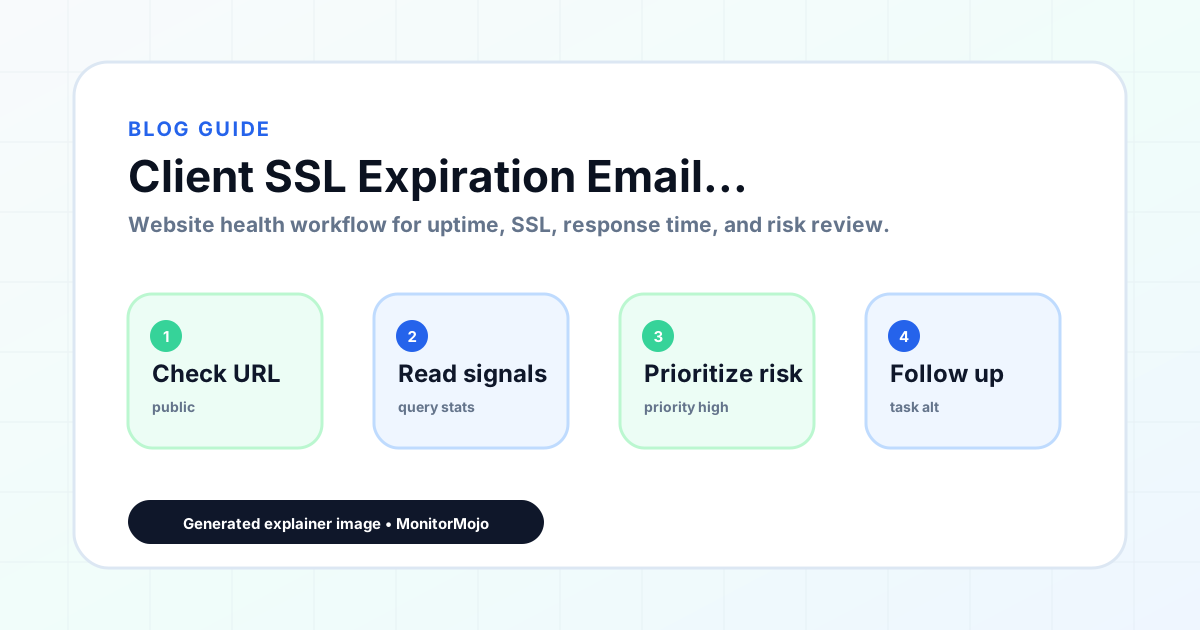
Step-by-step monitoring workflow
Start by listing the URLs that actually matter instead of just the homepage — for a small team doing a routine check before something breaks in front of a visitor, that usually means the pages tied to revenue, signups, or trust, not every page on the site.
Next, define the check types for each URL: reachability, HTTP status, HTTPS/SSL certificate status and expiry window, response time, redirect behavior, and security header presence. For API, CLI, and AI-agent workflows, document which endpoint or command runs the check and where the result is stored.
Set a cadence that matches the risk — a low-traffic page may only need a monthly look, while a page tied to revenue or signups deserves a check after every deployment and before any campaign or launch.
Record what you find with a consistent format: URL, check type, status, issue, owner, detected date, and next review date. Then say what actually happened in plain language — a check can surface a symptom, but site owners and small teams still need to confirm the cause.
- Choose the URLs that matter most to visitors, clients, revenue, and operations.
- Run uptime, SSL, response time, and security header checks on a consistent schedule.
- Triage failed or risky checks by likely owner: hosting, DNS, SSL, code, platform, or third party.
- Record notes in a repeatable format so future reviews do not start from scratch.
- Send a plain-language summary with the issue, impact, owner, and next review date.
- Run a confirmation check after remediation so there is an external result to reference.
Checklist or template
Use this template for recurring reviews: [URL], [Check Type], [Status], [Issue], [Priority], [Owner], [Detected Date], [Resolved Date], [Next Review Date]. Add a one-line summary at the top: what changed, what needs attention, and who owns the next step.
For site owners and small teams, group findings into the four signals that matter most: reachability, SSL status, response time, and security headers. Where nothing needs action, say the check found no issue in that area rather than implying full coverage.
- [URL]: the exact page or endpoint checked.
- [Check Type]: uptime, SSL, response time, headers, API, CLI, or agent workflow.
- [Status]: pass, review, failed, blocked, or needs human investigation.
- [Issue]: the observable symptom, not an unsupported root-cause claim.
- [Owner]: agency, developer, host, DNS provider, client, or third-party vendor.
- [Next Review Date]: when the team should confirm status again.
Common mistakes
The most common mistake is monitoring only the homepage while a checkout, signup, or booking flow silently breaks. Another is assuming SSL auto-renewal always works — it can fail quietly, and an external check is the only way to catch that before a browser warning does.
For site owners and small teams specifically, the recurring miss is treating one clean check as proof the whole site is fine, or fixing an issue without ever writing down what happened — which means the next person repeats the same investigation from zero.
- Tracking too many low-value URLs while missing the ones that matter.
- Skipping notes after an issue is resolved.
- Reporting a status without an owner or next step attached.
- Assuming automation can resolve an incident without human review.
- Treating one clean check as proof that every risk is covered.
Practical example
Consider a small team doing a routine check before something breaks in front of a visitor. A scheduled check flags that the site is slower than its usual baseline and that a security header is missing. Instead of guessing, the team logs the observation with a timestamp, assigns an owner, and re-checks after the fix ships — turning a vague "something feels off" into a specific, closed-loop task.
How MonitorMojo helps
MonitorMojo runs website health checks that combine reachability, SSL certificate status, response time, and security header presence in one workspace, so this workflow doesn't require stitching together several separate tools.
The API and CLI make the same checks scriptable for site owners and small teams who want them wired into an existing process, while credit-based checks keep it practical to run reviews exactly when they matter — before a client call, after a deploy, or when someone asks whether the site is healthy. Results still depend on hosting, DNS, and how quickly the responsible team acts on what the check finds.
Who this is for
- Agencies managing SSL certificates across multiple client domains
- Freelancers who handle hosting and certificate renewal for clients
- Anyone who has had a certificate lapse without warning in the past
- Teams that want a consistent, low-drama way to handle routine renewals
Frequently Asked Questions
How far in advance should I send the SSL expiration email?
Around 30 days out for the first notice works well for most clients, with a more direct follow-up around 7 days out if it hasn't been resolved. Adjust based on how quickly renewals typically get handled on your end.
Do I still need to email a client if the certificate auto-renews?
A lighter check-in is still worthwhile. Auto-renewal fails more often than expected — expired payment details, failed domain validation, or host-side issues can all cause a silent lapse even when renewal was supposed to be automatic.
What if the certificate already expired by the time I notice?
Use the urgent template and treat it with the same immediacy as a downtime issue, because from the visitor's perspective, an expired certificate often functions like one — browsers may block or warn against the site.
Does MonitorMojo renew the certificate for me?
No. MonitorMojo checks and reports SSL certificate status and days remaining — it does not renew certificates, manage DNS, or perform any actions on your hosting. Renewal is done through your certificate authority, host, or registrar.
Does sending this template guarantee the certificate gets renewed in time?
No. The email prompts action but doesn't perform it — renewal still depends on someone completing the steps with the certificate authority or host. A follow-up check after the deadline is the only way to confirm it actually happened.
Can this prevent every issue with the site?
No. Monitoring helps site owners and small teams detect website health signals and organize follow-up, but it does not prevent every outage, SSL issue, slow response, or third-party failure. The result still depends on hosting, DNS, infrastructure, and how quickly the responsible team investigates and responds.