MonitorMojo Blog
How to Create a Website Monitoring Operating System
A monitoring calendar tells you when to check things. An operating system is everything around that: who's responsible for what, which tools do which job, where findings get documented, and how a new team member learns the process without you explaining it from scratch every time. This guide covers building that fuller system, not just the schedule inside it. This expanded guide explains the practical monitoring workflow behind the topic, who should use it, what to check, how to document findings, and how to turn website health signals into useful client, developer, API, CLI, or AI-agent workflows without overstating what monitoring can prove.
The Pieces an Operating System Ties Together
Four things need to work together: a schedule (the monitoring calendar), a tool for running checks and storing results, a set of roles defining who does what, and documentation that makes the whole thing legible to someone who wasn't there when it was built. Most teams have one or two of these informally but not all four written down together.
Without this tying-together step, monitoring tends to live in one person's head and habits rather than in a system the team can rely on if that person is out, busy, or leaves.
The word "operating system" is a useful frame precisely because it implies something that runs continuously in the background of how the agency works, rather than a one-time project. It should be able to absorb a new client, a new team member, or a new tool without needing to be rebuilt from scratch each time.
Defining Roles
Assign clear ownership for each recurring piece of work, even on a small team where the same person covers multiple roles.
- Who runs the weekly and monthly checks (or maintains the scheduled scripts that do)
- Who reviews results and decides what needs follow-up
- Who owns client communication when something needs to go out
- Who's responsible for the quarterly report and recommendations
- Who's the backup for each of the above when the primary person is unavailable
Scaling the System as the Agency Grows
A one-person setup can run this whole system informally — one person doing checks, triage, and client communication with a simple personal checklist. As an agency adds staff and clients, the same four pieces (schedule, tools, roles, documentation) still apply, but roles start splitting across people, and the documentation step becomes more important because it's no longer all living in one person's working memory.
Revisit role assignments whenever the team changes meaningfully — a new hire, someone moving to a different role, or a client base that's grown large enough that one person can no longer reasonably cover triage for everything. Treating the operating system as something that evolves with the team, rather than a fixed structure set once, keeps it useful as the agency scales.
Choosing and Connecting Tools
The operating system doesn't need many tools, but it needs the ones it has to fit together. A check-running tool (like MonitorMojo, via dashboard, API, or CLI), a place to log results and findings (a shared spreadsheet or doc is enough for most small teams), and a place to store the email templates and escalation rules so they're not being recreated from memory each time.
Resist the temptation to add tools for their own sake. A well-maintained spreadsheet that everyone actually uses beats an elaborate dashboard nobody opens. Add complexity only when the simple version is genuinely breaking down.
When choosing where to store check results and findings, favor whatever tool the team already checks daily over introducing a new one specifically for monitoring. A monitoring log that lives in a tool people forget to open defeats its own purpose, no matter how well designed it is.
Documenting the System
Write down, in one place, the calendar (what gets checked and when), the severity framework used for triage, the escalation tiers and time limits, and links to the email templates. This doesn't need to be long — a single page that a new hire could read and understand the whole process from is the goal.
Include a short section on what MonitorMojo does and doesn't do as part of this documentation, especially for anyone new to the process. It's a small thing, but making explicit that checks are on-demand rather than continuous, and that alerts aren't sent automatically, avoids a new team member assuming the tool is doing more than it actually is and skipping a step they think is automated.
Review this documentation at least once a quarter, ideally alongside the quarterly client review cycle, since that's already the point where you're stepping back to assess whether the overall approach is still working.
Common Mistakes
Building an elaborate system before the basics (a schedule, a place to log results) are solid wastes effort on structure the team doesn't have the habits to support yet. Start simple and formalize as patterns emerge.
Leaving the whole system in one person's head is the most common failure mode — if only one person knows the escalation rules or where the templates live, the system doesn't survive that person taking a vacation.
Never revisiting the documented process means it quietly stops matching reality — new clients get added, tools change, and the written system falls behind what people actually do.
Confusing the operating system with the calendar is a common category error — the calendar is one piece of the system, not the whole thing; roles, tools, and documentation are just as important.
Designing the system around a single specific tool rather than the underlying process is a subtler mistake — if the check-running tool ever changes, a system built entirely around that tool's specific quirks has to be rebuilt, whereas one built around roles and a documented process just swaps in a new tool for the same role.
How MonitorMojo Helps
MonitorMojo functions as the check-running layer of the operating system — the dashboard for manual checks, the API and CLI for scheduled ones, and check history as the persistent record that doesn't depend on any one person's memory or notes.
Because access to the dashboard and API isn't limited to a single person's login working alone, the operating system's backup coverage (who steps in when the primary owner is out) is straightforward to support — anyone with access can re-run a check and see the same history.
Client-ready summaries give the documentation piece a consistent output format, so the reporting side of the system produces the same kind of deliverable regardless of who's running it that quarter.
What this workflow means
How to Create a Website Monitoring Operating System is best understood as a repeatable website health workflow, not a promise that every outage or configuration issue will be avoided. How to build the fuller process behind website monitoring — roles, tools, documentation, and how the calendar, checks, and client communication fit together as one system.
In practice, this workflow centers on uptime, SSL certificates, response time, security headers, website health summaries, and monthly review notes. Each check is planning input: it can show that the site is reachable, that a certificate has a given expiry window, that response time has shifted, or that a header is missing. It cannot prove root cause by itself or replace a human response. The value is in making the review consistent enough that site owners and small teams can spot issues before someone downstream has to ask about them.
Who should use this
This is most useful for site owners and small teams. Agencies formalizing monitoring beyond one person's informal habits
Beyond that primary audience, the same checks are reusable by anyone with a public-facing URL that matters to revenue, leads, or reputation: a recurring review is cheap insurance compared to hearing about the problem from a client or customer first.
Step-by-step monitoring workflow
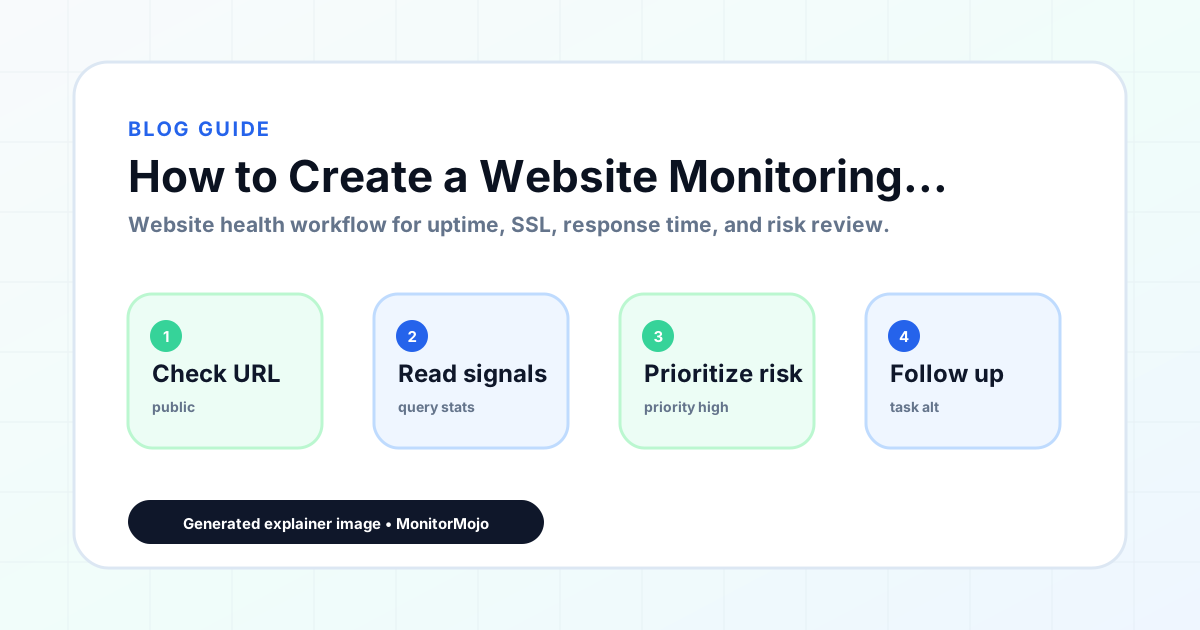
Start by listing the URLs that actually matter instead of just the homepage — for a small team doing a routine check before something breaks in front of a visitor, that usually means the pages tied to revenue, signups, or trust, not every page on the site.
Next, define the check types for each URL: reachability, HTTP status, HTTPS/SSL certificate status and expiry window, response time, redirect behavior, and security header presence. For API, CLI, and AI-agent workflows, document which endpoint or command runs the check and where the result is stored.
Set a cadence that matches the risk — a low-traffic page may only need a monthly look, while a page tied to revenue or signups deserves a check after every deployment and before any campaign or launch.
Record what you find with a consistent format: URL, check type, status, issue, owner, detected date, and next review date. Then say what actually happened in plain language — a check can surface a symptom, but site owners and small teams still need to confirm the cause.
- Choose the URLs that matter most to visitors, clients, revenue, and operations.
- Run uptime, SSL, response time, and security header checks on a consistent schedule.
- Triage failed or risky checks by likely owner: hosting, DNS, SSL, code, platform, or third party.
- Record notes in a repeatable format so future reviews do not start from scratch.
- Send a plain-language summary with the issue, impact, owner, and next review date.
- Run a confirmation check after remediation so there is an external result to reference.
Checklist or template
Use this template for recurring reviews: [URL], [Check Type], [Status], [Issue], [Priority], [Owner], [Detected Date], [Resolved Date], [Next Review Date]. Add a one-line summary at the top: what changed, what needs attention, and who owns the next step.
For site owners and small teams, group findings into the four signals that matter most: reachability, SSL status, response time, and security headers. Where nothing needs action, say the check found no issue in that area rather than implying full coverage.
- [URL]: the exact page or endpoint checked.
- [Check Type]: uptime, SSL, response time, headers, API, CLI, or agent workflow.
- [Status]: pass, review, failed, blocked, or needs human investigation.
- [Issue]: the observable symptom, not an unsupported root-cause claim.
- [Owner]: agency, developer, host, DNS provider, client, or third-party vendor.
- [Next Review Date]: when the team should confirm status again.
Common mistakes
The most common mistake is monitoring only the homepage while a checkout, signup, or booking flow silently breaks. Another is assuming SSL auto-renewal always works — it can fail quietly, and an external check is the only way to catch that before a browser warning does.
For site owners and small teams specifically, the recurring miss is treating one clean check as proof the whole site is fine, or fixing an issue without ever writing down what happened — which means the next person repeats the same investigation from zero.
- Tracking too many low-value URLs while missing the ones that matter.
- Skipping notes after an issue is resolved.
- Reporting a status without an owner or next step attached.
- Assuming automation can resolve an incident without human review.
- Treating one clean check as proof that every risk is covered.
Practical example
Consider a small team doing a routine check before something breaks in front of a visitor. A scheduled check flags that the site is slower than its usual baseline and that a security header is missing. Instead of guessing, the team logs the observation with a timestamp, assigns an owner, and re-checks after the fix ships — turning a vague "something feels off" into a specific, closed-loop task.
How MonitorMojo helps
MonitorMojo runs website health checks that combine reachability, SSL certificate status, response time, and security header presence in one workspace, so this workflow doesn't require stitching together several separate tools.
The API and CLI make the same checks scriptable for site owners and small teams who want them wired into an existing process, while credit-based checks keep it practical to run reviews exactly when they matter — before a client call, after a deploy, or when someone asks whether the site is healthy. Results still depend on hosting, DNS, and how quickly the responsible team acts on what the check finds.
Who this is for
- Agencies formalizing monitoring beyond one person's informal habits
- Teams onboarding new staff who need to learn the monitoring process quickly
- Anyone whose monitoring process currently only exists in one person's head
- Agencies scaling client count and needing the process to hold up without them personally running every check
Frequently Asked Questions
How is an operating system different from a monitoring calendar?
The calendar is the schedule — what gets checked and when. The operating system is the fuller picture: roles, tools, documentation, and how the calendar, checks, and client communication connect into one repeatable process.
Do I need a formal operating system if I'm a solo freelancer?
A lighter version still helps — even solo, writing down your own severity levels, escalation habits, and where templates live means you're not reinventing the process under pressure during an actual incident.
How much documentation is actually needed?
Less than people expect. A single page covering the calendar, severity framework, escalation rules, and links to templates is usually enough for a small team — the goal is that someone new could follow it, not that it covers every edge case.
Does MonitorMojo provide the whole operating system for me?
No. MonitorMojo provides the check-running and history layer — reachability, SSL, response time, and header checks, saved history, API/CLI access, and client summaries. The roles, escalation rules, and documentation around it are something your team builds.
Does having a documented operating system guarantee consistent monitoring quality?
No. It significantly reduces the risk of the process depending on one person's memory, but it still depends on people actually following it, and it doesn't guarantee every issue gets caught or prevented.
Can this prevent every issue with the site?
No. Monitoring helps site owners and small teams detect website health signals and organize follow-up, but it does not prevent every outage, SSL issue, slow response, or third-party failure. The result still depends on hosting, DNS, infrastructure, and how quickly the responsible team investigates and responds.