MonitorMojo Blog
SaaS Uptime Monitoring for Early-Stage Founders
For an early-stage SaaS founder, the public-facing website is doing a lot of work: converting curious visitors to trial signups, establishing credibility for outbound conversations, and staying available during the demo and evaluation period for every prospective customer. When something goes wrong — a broken SSL certificate, a slow marketing page, an unreachable signup flow — it is not an abstract monitoring problem. It is a real prospect who did not convert. SaaS uptime monitoring is about protecting the top of your funnel with minimal operational overhead. This expanded guide explains the practical monitoring workflow behind the topic, who should use it, what to check, how to document findings, and how to turn website health signals into useful client, developer, API, CLI, or AI-agent workflows without overstating what monitoring can prove.
What early-stage SaaS founders need to monitor
At the earliest stages, SaaS founders do not need enterprise observability. They need reliable visibility into the signals that affect whether prospects can find, evaluate, and sign up for the product. That means monitoring the marketing site, the signup or trial start flow, and any public-facing page that prospects reach before converting.
The signals worth tracking for a SaaS marketing site are: whether the site is reachable and returning success responses, whether HTTPS is active and the SSL certificate is not about to expire, how quickly the site responds on pages prospects visit during evaluation, and whether basic security protections are in place that signal trustworthiness to security-conscious buyers.
Deep application monitoring — error rates within the application, database query performance, internal API latency — is typically covered by whatever observability stack the product runs on. Public-facing website health monitoring is the complementary layer that covers what prospects experience before they become users.
SSL is not optional for SaaS credibility
A SaaS product asking for a credit card or business account access needs a valid, functioning SSL certificate with no browser warnings. Security-conscious buyers — and enterprise evaluators in particular — check the padlock icon before entering payment information or credentials. A browser warning on the signup page at any point during evaluation is a trust signal failure that costs deals.
The risk for early-stage founders is that the email address associated with the SSL certificate, hosting, and domain registration is often the founder's personal email or an early company address that is no longer actively monitored. Renewal reminders arrive at an inbox that does not get checked, and the certificate expires while everyone is focused on building the product.
Including SSL certificate status in a regular check workflow — even just monthly — catches this before it becomes a prospect-facing failure. A certificate expiring in 45 days is a five-minute fix. A certificate that expired during a product demo is a much worse problem.
Signup flow availability: the highest-value URL to monitor
For a SaaS product, the signup or trial start page is the single highest-value URL to monitor. If the marketing site goes down, prospects cannot learn about the product. If the signup page breaks, everyone who was convinced to try the product cannot act on that conviction. Both matter; the signup flow is where a broken page translates most directly to missed revenue.
Many early-stage SaaS products run their signup flow on a different subdomain from the marketing site. The marketing site might be on a CMS while the signup flow runs on the application platform. Both need to be checked independently — a failure in either place creates a gap in the conversion funnel.
After any deployment to either the marketing site or the application, run a health check on both. These are the moments when URL changes, subdomain configuration errors, and SSL certificate issues are most likely to appear without anyone immediately noticing.
Response time on SaaS marketing pages
Prospect behavior on a SaaS marketing site is different from e-commerce browsing. Prospects arrive with specific questions — how does pricing work, what integrations exist, can I see a demo — and need to find answers quickly enough to stay engaged. A marketing site that takes four seconds to load is losing prospects who will not wait, particularly on mobile.
Response time matters most on the pages that carry the most evaluation weight: the homepage, pricing page, features page, and demo request form. These are where prospects make the decision to continue or leave. Slow response time on any of them costs conversion.
For early-stage SaaS products hosted on budget or shared hosting to keep costs low, response time monitoring catches the moment when the hosting plan is no longer keeping up with traffic. A 200ms response time that has grown to 1.5 seconds over six months is a signal that the hosting tier needs revisiting before it starts noticeably affecting signups.
Security signals that matter to SaaS buyers
Security-conscious buyers — enterprise evaluators, legal and compliance teams, technical decision-makers — look for visible security signals on a SaaS vendor's website before engaging. HTTPS is table stakes. Security headers add a layer of hygiene that a technical reviewer checking your site will notice during due diligence.
For early-stage SaaS products without a dedicated security team, maintaining the basic security header set is achievable without significant overhead. The headers most relevant to SaaS marketing sites are HSTS, X-Frame-Options, and X-Content-Type-Options. These can be configured at the CDN or hosting level in under an hour and checked monthly to confirm they remain in place.
MonitorMojo helps monitor uptime, SSL, response time, and basic website risk signals for SaaS public pages, but it does not replace a professional security audit or penetration test. For SaaS products handling sensitive customer data, a proper security assessment is a separate and important investment.
Practical monitoring for founders with limited time
The most common monitoring failure for early-stage SaaS founders is not choosing the wrong tool — it is not having time to maintain a monitoring workflow. A monitoring setup that requires ongoing configuration, per-URL subscriptions, and alert management adds overhead that competes with everything else on the founder's plate.
For most early-stage SaaS products, a monthly health check on the marketing site and signup flow is a practical starting point. It takes a few minutes per check, catches the SSL expiry and response time signals that matter most, and creates a minimal record of monitoring activity.
MonitorMojo's credit-based pricing fits this workflow: you buy a pack of checks and use them when you need them, without a monthly subscription that charges you whether you check or not. As the product grows and monitoring needs become more sophisticated, the workflow can scale accordingly.
- Monitor your homepage, pricing page, and signup flow as three separate checks
- Run a check before and after every marketing site deployment
- Track SSL expiry for both the marketing site and any app.* subdomains separately
- Check response time on the pricing page — it is often the most conversion-sensitive
- Include security header status in any vendor security questionnaire documentation
What this workflow means
SaaS Uptime Monitoring for Early-Stage Founders is best understood as a repeatable website health workflow, not a promise that every outage or configuration issue will be avoided. Learn how early-stage SaaS founders should approach uptime monitoring for their marketing site, signup flow, and public pages — without enterprise monitoring overhead.
In practice, this workflow centers on reachability, HTTP status, downtime triage, stakeholder updates, and confirmation checks. Each check is planning input: it can show that the signup page is reachable, that a certificate has a given expiry window, that response time has shifted, or that a header is missing. It cannot prove root cause by itself or replace a human response. The value is in making the review consistent enough that SaaS founders and startup teams can spot issues before someone downstream has to ask about them.
Who should use this
This is most useful for SaaS founders and startup teams. Early-stage SaaS founders monitoring their marketing site and signup flow
Beyond that primary audience, the same checks are reusable by anyone with a public-facing URL that matters to revenue, leads, or reputation: a recurring review is cheap insurance compared to hearing about the problem from a client or customer first.
Step-by-step monitoring workflow
Start by listing the URLs that actually matter instead of just the homepage — for a SaaS founder confirming signup and pricing pages after a deploy, that usually means the pages tied to revenue, signups, or trust, not every page on the site.
Next, define the check types for each URL: reachability, HTTP status, HTTPS/SSL certificate status and expiry window, response time, redirect behavior, and security header presence. For API, CLI, and AI-agent workflows, document which endpoint or command runs the check and where the result is stored.
Set a cadence that matches the risk — a low-traffic page may only need a monthly look, while a page tied to revenue or signups deserves a check after every deployment and before any campaign or launch.
Record what you find with a consistent format: URL, check type, status, issue, owner, detected date, and next review date. Then say what actually happened in plain language — a check can surface a symptom, but SaaS founders and startup teams still need to confirm the cause.
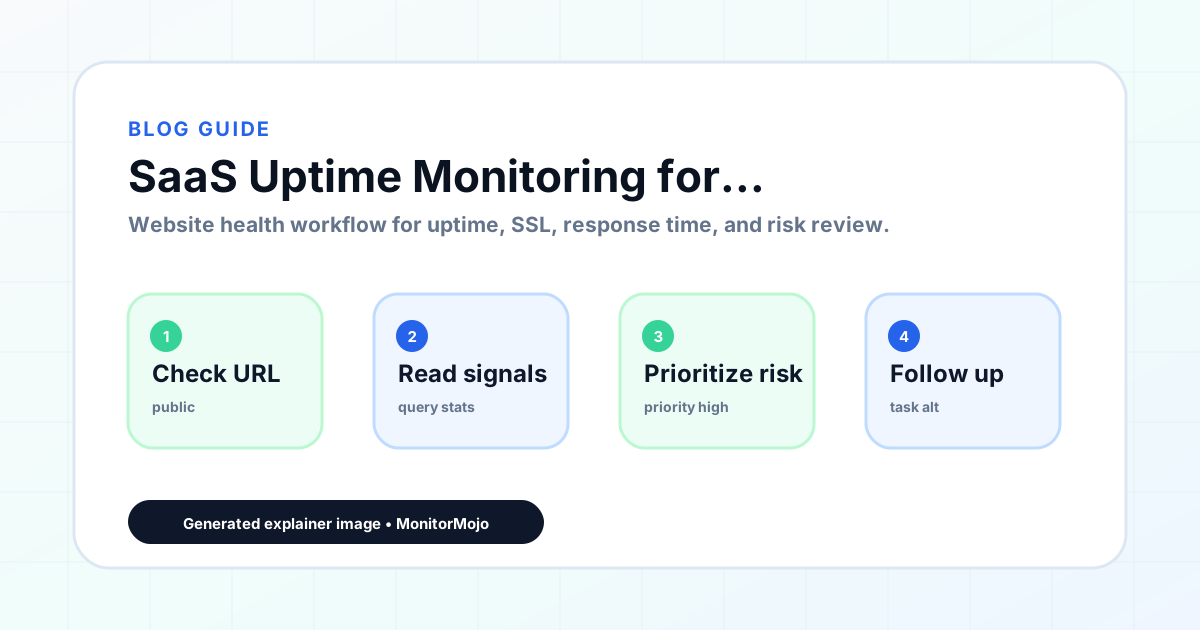
- Choose the URLs that matter most to visitors, clients, revenue, and operations.
- Run uptime, SSL, response time, and security header checks on a consistent schedule.
- Triage failed or risky checks by likely owner: hosting, DNS, SSL, code, platform, or third party.
- Record notes in a repeatable format so future reviews do not start from scratch.
- Send a plain-language summary with the issue, impact, owner, and next review date.
- Run a confirmation check after remediation so there is an external result to reference.
Checklist or template
Use this template for recurring reviews: [URL], [Check Type], [Status], [Issue], [Priority], [Owner], [Detected Date], [Resolved Date], [Next Review Date]. Add a one-line summary at the top: what changed, what needs attention, and who owns the next step.
For SaaS founders and startup teams, group findings into the four signals that matter most: reachability, SSL status, response time, and security headers. Where nothing needs action, say the check found no issue in that area rather than implying full coverage.
- [URL]: the exact page or endpoint checked.
- [Check Type]: uptime, SSL, response time, headers, API, CLI, or agent workflow.
- [Status]: pass, review, failed, blocked, or needs human investigation.
- [Issue]: the observable symptom, not an unsupported root-cause claim.
- [Owner]: agency, developer, host, DNS provider, client, or third-party vendor.
- [Next Review Date]: when the team should confirm status again.
Common mistakes
The most common mistake is monitoring only the homepage while a checkout, signup, or booking flow silently breaks. Another is assuming SSL auto-renewal always works — it can fail quietly, and an external check is the only way to catch that before a browser warning does.
For SaaS founders and startup teams specifically, the recurring miss is treating one clean check as proof the whole site is fine, or fixing an issue without ever writing down what happened — which means the next person repeats the same investigation from zero.
- Tracking too many low-value URLs while missing the ones that matter.
- Skipping notes after an issue is resolved.
- Reporting a status without an owner or next step attached.
- Assuming automation can resolve an incident without human review.
- Treating one clean check as proof that every risk is covered.
Practical example
Consider a SaaS founder confirming signup and pricing pages after a deploy. A scheduled check flags that the signup page is slower than its usual baseline and that a security header is missing. Instead of guessing, the team logs the observation with a timestamp, assigns an owner, and re-checks after the fix ships — turning a vague "something feels off" into a specific, closed-loop task.
How MonitorMojo helps
MonitorMojo runs website health checks that combine reachability, SSL certificate status, response time, and security header presence in one workspace, so this workflow doesn't require stitching together several separate tools.
The API and CLI make the same checks scriptable for SaaS founders and startup teams who want them wired into an existing process, while credit-based checks keep it practical to run reviews exactly when they matter — before a client call, after a deploy, or when someone asks whether the signup page is healthy. Results still depend on hosting, DNS, and how quickly the responsible team acts on what the check finds.
Who this is for
- Early-stage SaaS founders monitoring their marketing site and signup flow
- Indie hackers and bootstrappers managing public-facing product pages
- Small SaaS teams without a dedicated operations or DevOps function
- Product teams responsible for uptime during customer evaluations and sales cycles
- SaaS founders preparing for growth who want a monitoring foundation before scaling
Frequently Asked Questions
Do early-stage SaaS products need enterprise monitoring tools?
No. Enterprise monitoring tools add cost and operational complexity that early-stage SaaS teams cannot absorb. A focused website health check tool covering SSL, response time, reachability, and security headers on public-facing pages is the right starting point — you can add more sophisticated observability as the product and team scale.
What is the most important monitoring signal for a SaaS marketing site?
SSL certificate status and availability of the signup or trial start page are typically the highest-priority signals. A browser warning on the signup page costs signups directly. Unavailability during an active evaluation or demo period can cost deals outright.
Should I monitor my app subdomain and marketing site separately?
Yes. They are often on different infrastructure — different subdomains, different hosting providers, potentially different SSL certificates. Monitoring both ensures you catch failures in either layer. A functioning marketing site with a broken signup flow still costs you conversions.
How does response time affect SaaS signups?
Slow marketing pages lose prospects before they reach the signup form. Security-conscious evaluators interpret slow sites as a signal about product quality. On mobile, long load times cause visitors to abandon pages before conversion. Response time is a conversion metric as much as a performance metric.
What monitoring should I set up before a product launch?
Before launch, run health checks on your homepage, pricing page, and signup flow. Confirm all are reachable, SSL is valid with sufficient time remaining, response time is acceptable, and key security headers are in place. Run another check immediately after launch to confirm nothing broke during the go-live process.
Can this prevent every issue with the signup page?
No. Monitoring helps SaaS founders and startup teams detect website health signals and organize follow-up, but it does not prevent every outage, SSL issue, slow response, or third-party failure. The result still depends on hosting, DNS, infrastructure, and how quickly the responsible team investigates and responds.